Nous utilisons des cookies pour améliorer votre expérience. Pour nous conformer à la nouvelle directive sur la vie privée, nous devons demander votre consentement à l’utilisation de ces cookies. En savoir plus.

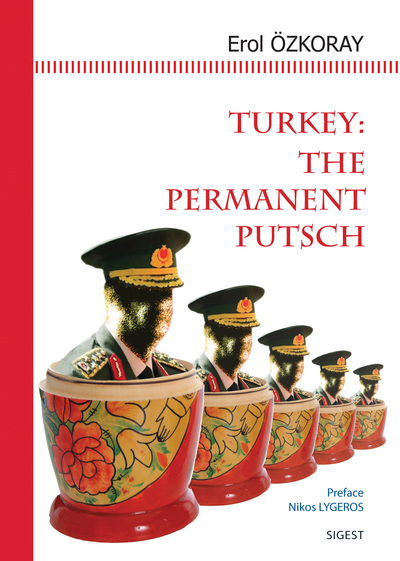
TURKEY: THE PERMANENT PUTSCH
Sigest - EAN : 9782917329221
Édition papier
EAN : 9782917329221
Paru le : 3 mars 2011
7,95 €
7,54 €
Disponible
Pour connaître votre prix et commander, identifiez-vous
Notre engagement qualité
-
 Livraison gratuite
en France sans minimum
de commande -
 Manquants maintenus
en commande
automatiquement -
 Un interlocuteur
unique pour toutes
vos commandes -
 Toutes les licences
numériques du marché
au tarif éditeur -
 Assistance téléphonique
personalisée sur le
numérique -
 Service client
Du Lundi au vendredi
de 9h à 18h
- EAN13 : 9782917329221
- Collection : VIE POLITIQUE
- Editeur : Sigest
- Date Parution : 3 mars 2011
- Disponibilite : Disponible
- Barème de remise : NS
- Nombre de pages : 56
- Format : H:165 mm L:120 mm E:3 mm
- Poids : 90gr
- Résumé : Turkey’s political regime is at present the most anachronistic and most archaic of all Europe. It is a "insidious totalitarianism," in which the true power is exercised by the Turkish army. Several institutions, such as the National Security Council, in which members of the military sit, have as their goal the control and censorship of the civilian government. This regime, born of the military coup d’état of 1980, is based on the constitution of 1982 in order to place the power of the military on a firmer footing. There furthermore exists a secret pseudo-constitution called the National Security Policy Document, which enumerates the inviolable red lines for the Turkish state, including the Kurdish problem, the Cyprus issue, and the Armenian Genocide. No solution to these major problems is possible in this system where the military reigns as master. This schizophrenic regime, where elected officials do not hold the true power, is characterized by the author as a regime of "permanent putsch" or "permanent coup d’état." The process of accession to the European Union plays a large role in the political normalization of the country. In this context, the Ergenekon trial against the putschists of the Turkish army is the first break in dismantling this power. However, much more remains to be done.