Nous utilisons des cookies pour améliorer votre expérience. Pour nous conformer à la nouvelle directive sur la vie privée, nous devons demander votre consentement à l’utilisation de ces cookies. En savoir plus.

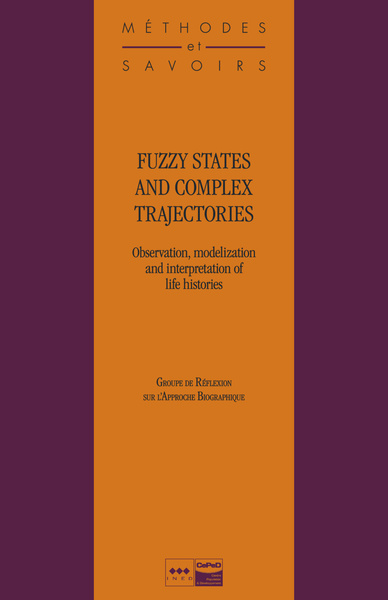
Fuzzy states and complex trajectories
Ined - EAN : 9782733260067
Édition papier
EAN : 9782733260067
Paru le : 23 mars 2009
18,00 €
17,06 €
Disponible
Pour connaître votre prix et commander, identifiez-vous
Notre engagement qualité
-
 Livraison gratuite
en France sans minimum
de commande -
 Manquants maintenus
en commande
automatiquement -
 Un interlocuteur
unique pour toutes
vos commandes -
 Toutes les licences
numériques du marché
au tarif éditeur -
 Assistance téléphonique
personalisée sur le
numérique -
 Service client
Du Lundi au vendredi
de 9h à 18h
- EAN13 : 9782733260067
- Réf. fournisseur : 120827-105
- Collection : METHODES ET
- Editeur : Ined
- Date Parution : 23 mars 2009
- Disponibilite : Disponible
- Barème de remise : NS
- Nombre de pages : 176
- Format : H:240 mm L:155 mm E:10 mm
- Poids : 350gr
-
Résumé :
Individuals experience a variety of different events throughout their life-course – birth, marriage, change of employment, school graduation, etc. – which sometimes occur in rapid succession, and whose timing and definition may seem unclear. Now that survey questionnaires are able to record individual trajectories in greater depth, changes of status can no longer be viewed simply as separate events, but involve a transition process of variable duration. The observation, modelling and interpretation of these fuzzy thresholds between two situations constitute a dynamic field of research in the social sciences. The authors of this manual have pooled their experience of event-history data collection to address the questions of “focus”, i.e. finding the right observation distance to grasp the complexity of life histories, and of time, i.e. choosing the right timescale of detailed information collection. After analysing the links between quantitative and qualitative data, addressing the distinction between facts and perceptions, and deconstructing analysis data categories, they offer a number of conceptual and methodological solutions. This study extends beyond the scope of specific examples to develop a major empirical approach in a still largely unexplored area. This book targets a much broader audience than the community of demographers alone. It concerns everyone in the field of social sciences who, at one moment or another, is required to organize data collection in the field, either for research or practical purposes.
The Groupe de réflexion sur l’approche biographique (GRAB) brings together researchers and academics from a range of institutions (INED, IRD, CNRS, etc.) working in a variety of disciplines: demography, geography, sociology, economics, etc. It is building on the experience acquired through 25 event-history surveys conducted to date in France, Africa and Latin America.