Nous utilisons des cookies pour améliorer votre expérience. Pour nous conformer à la nouvelle directive sur la vie privée, nous devons demander votre consentement à l’utilisation de ces cookies. En savoir plus.

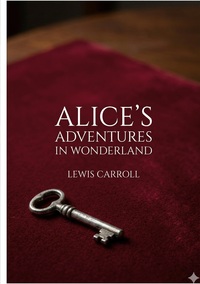
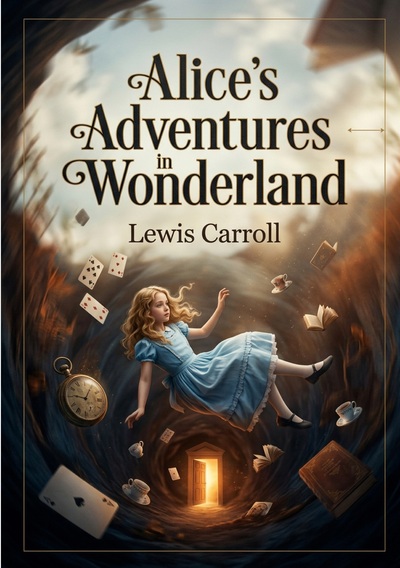
Alice's Adventures in Wonderland (original and unabridged edition)
EAN : 9791043122514
Édition papier
EAN : 9791043122514
Paru le : 23 juin 2026
14,90 €
14,12 €
Disponible
Pour connaître votre prix et commander, identifiez-vous
Notre engagement qualité
-
 Livraison gratuite
en France sans minimum
de commande -
 Manquants maintenus
en commande
automatiquement -
 Un interlocuteur
unique pour toutes
vos commandes -
 Toutes les licences
numériques du marché
au tarif éditeur -
 Assistance téléphonique
personalisée sur le
numérique -
 Service client
Du Lundi au vendredi
de 9h à 18h
- EAN13 : 9791043122514
- Réf. fournisseur : 456952
- Date Parution : 23 juin 2026
- Disponibilite : Disponible
- Barème de remise : NS
- Nombre de pages : 136
- Format : H:210 mm L:148 mm E:8 mm
- Poids : 187gr
- Résumé : Alice's Adventures in Wonderland is a novel written by Charles Lutwidge Dodgson under the pseudonym Lewis Carroll, published by Macmillan in 1865. The narrative follows a young girl named Alice who falls through a rabbit hole into a subterranean fantasy world populated by anthropomorphic creatures. The tale plays with logic, giving the story lasting popularity with adults as well as with children. It is considered one of the best-known works of Victorian literature and the nonsense genre. Structure of the Narrative The novel is composed of twelve chapters. It begins with "Down the Rabbit-Hole", where Alice follows the White Rabbit. The subsequent chapters detail her encounters with various creatures and her struggles with her changing size. Chapters include "The Pool of Tears", "A Caucus-Race and a Long Tale", "The Rabbit Sends in a Little Bill", "Advice from a Caterpillar", "Pig and Pepper", "A Mad Tea-Party", "The Queen's Croquet-Ground", "The Mock Turtle's Story", "The Lobster Quadrille", "Who Stole the Tarts?", and "Alice's Evidence". The narrative is episodic, driven by Alice's attempts to navigate the rules of Wonderland, culminating in the trial of the Knave of Hearts before Alice wakes up. Primary Characters The White Rabbit serves as the catalyst for the journey, characterized by his waistcoat and pocket watch. The Cheshire Cat is known for his distinctive grin, his ability to disappear gradually, and his philosophical conversations with Alice. The Hatter and the March Hare are participants in the perpetual tea party, trapped in time at six o'clock because the Hatter "murdered the time". The Queen of Hearts is the tyrannical ruler of Wonderland, characterized by her quick temper and her decrees of capital punishment. She operates a croquet game using live flamingos as mallets. The Mock Turtle and the Gryphon introduce Alice to the "Lobster Quadrille" and relate puns about their education at the bottom of the sea. Thematic Elements The text presents an inversion of Victorian educational norms. Rather than imparting moral lessons, the story relies on absurdity. Carroll parodies the didactic poetry and rote learning of his era. Poems such as "How Doth the Little Crocodile" are direct parodies of Isaac Watts. Another central theme is the concept of identity. Alice frequently questions who she is, particularly when her physical size changes. The Caterpillar directly asks her "Who are you?", to which Alice struggles to respond. Logic and linguistics are heavily featured. Carroll, a mathematician, integrates logical fallacies and mathematical concepts into the dialogue. The Mad Tea-Party scene involves riddles with no answers, such as "Why is a raven like a writing-desk?". The theme of childhood versus adulthood is present in the contrast between Alice's rational attempts to understand Wonderland and the arbitrary behavior of the adult figures she encounters. Historical Context The story originated on July 4, 1862, during a boat trip on the River Thames. Dodgson told the story to Alice Liddell and her sisters. He completed a manuscript titled Alice's Adventures Under Ground in 1864, which he illustrated himself. He later expanded the text, adding the Mad Tea-Party and the Cheshire Cat, increasing the word count from 15,500 to 27,500 words. The book was published in 1865 by Macmillan with illustrations by John Tenniel. The first print run was withdrawn because Tenniel objected to the print quality. A new edition, released in December 1865, was printed. It was followed by a sequel in 1871. The text has been translated into over 170 languages. Genre and Target Audience The book is classified as literary nonsense and children's fantasy. It utilizes the structure of a dream vision, which excuses the lack of logical progression. In nineteenth-century literature, it stands apart from the prevailing realism. While directed at children, the mathematical and linguistic jokes have sustained an adult readership.