Nous utilisons des cookies pour améliorer votre expérience. Pour nous conformer à la nouvelle directive sur la vie privée, nous devons demander votre consentement à l’utilisation de ces cookies. En savoir plus.

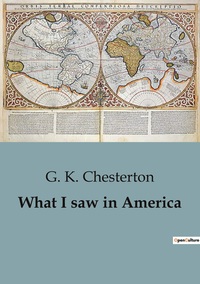
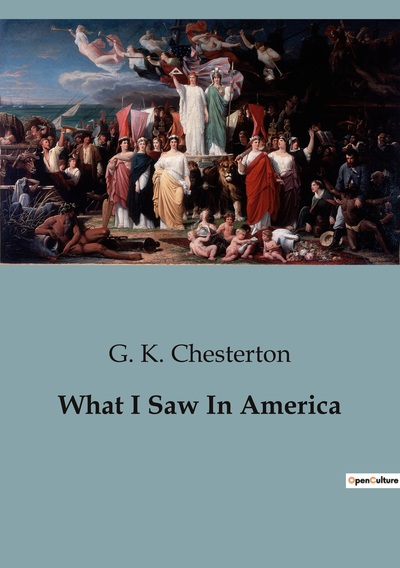
What I Saw In America
EAN : 9791041947508
Édition papier
EAN : 9791041947508
Paru le : 13 mars 2023
21,00 €
19,91 €
Disponible
Pour connaître votre prix et commander, identifiez-vous
Notre engagement qualité
-
 Livraison gratuite
en France sans minimum
de commande -
 Manquants maintenus
en commande
automatiquement -
 Un interlocuteur
unique pour toutes
vos commandes -
 Toutes les licences
numériques du marché
au tarif éditeur -
 Assistance téléphonique
personalisée sur le
numérique -
 Service client
Du Lundi au vendredi
de 9h à 18h
- EAN13 : 9791041947508
- Réf. fournisseur : 271270
- Date Parution : 13 mars 2023
- Disponibilite : Disponible
- Barème de remise : NS
- Nombre de pages : 168
- Format : H:210 mm L:148 mm E:9 mm
- Poids : 226gr
- Résumé : In "What I Saw in America," G. K. Chesterton embarks on a journey across the United States, offering a reflective and often humorous examination of American society and its underlying principles. Chesterton begins by challenging the notion that travel broadens the mind, suggesting instead that it can narrow perspectives unless approached with humility and imagination. He explores the American identity, emphasizing the nation's foundational basis on a creed of equality and democracy, as articulated in the Declaration of Independence. This creed, he argues, sets America apart from other nations, which are often bound by racial or nationalistic ties rather than shared ideals. Chesterton delves into the American experience through various lenses, including the architecture and social dynamics of American hotels, which he contrasts with the traditional English inn. He observes the uniformity and efficiency of these establishments, noting how they reflect broader societal values of equality and practicality. His exploration extends to the vibrant and bustling streets of New York, where he muses on the influence of modernity and commercialism on the human spirit. Throughout his travels, Chesterton maintains a balance between critique and admiration, acknowledging the challenges posed by America's diverse population and the tensions between its ideals and realities. He highlights the importance of understanding and respecting the American experiment, which seeks to forge a cohesive national identity from a tapestry of different cultures and backgrounds. Ultimately, Chesterton's reflections offer a nuanced perspective on the complexities of American life and the enduring quest for a more perfect union.
- Biographie : Gilbert Keith Chesterton (1874-1936) était un écrivain, philosophe, dramaturge, journaliste et critique littéraire anglais, largement reconnu pour son esprit incisif et sa plume prolifique. Né à Londres, Chesterton a étudié à la Slade School of Fine Art avant de se tourner vers l'écriture. Chesterton est surtout connu pour ses romans, ses essais et ses nouvelles. Parmi ses oeuvres les plus célèbres, on trouve "L'Homme qui était Jeudi" et la série de nouvelles mettant en scène le père Brown, un prêtre détective. Son style unique, caractérisé par un humour brillant, des paradoxes et une profonde réflexion philosophique, a fait de lui une figure centrale de la littérature anglaise du début du XXe siècle. En tant que critique social et littéraire, Chesterton a écrit sur une variété de sujets, allant de la théologie à la politique, en passant par l'art et la littérature. Ses essais, publiés dans des journaux et des revues, étaient appréciés pour leur clarté de pensée et leur capacité à rendre accessibles des concepts complexes. La conversion de Chesterton au catholicisme en 1922 a influencé une grande partie de son travail ultérieur, ajoutant une dimension spirituelle et théologique à ses écrits. Il a utilisé sa plume pour défendre la foi et critiquer le matérialisme et le relativisme de son époque. Outre sa carrière littéraire, Chesterton était un conférencier populaire et un débatteur public. Son charisme et son talent oratoire attiraient de larges audiences, et ses débats avec des figures contemporaines telles que George Bernard Shaw sont restés célèbres. Gilbert Keith Chesterton est décédé en 1936, mais son héritage perdure à travers ses nombreux écrits, qui continuent d'inspirer et de provoquer la réflexion. Son oeuvre reste un témoignage de son génie littéraire et de sa capacité à combiner humour, profondeur philosophique et critique sociale.