Nous utilisons des cookies pour améliorer votre expérience. Pour nous conformer à la nouvelle directive sur la vie privée, nous devons demander votre consentement à l’utilisation de ces cookies. En savoir plus.

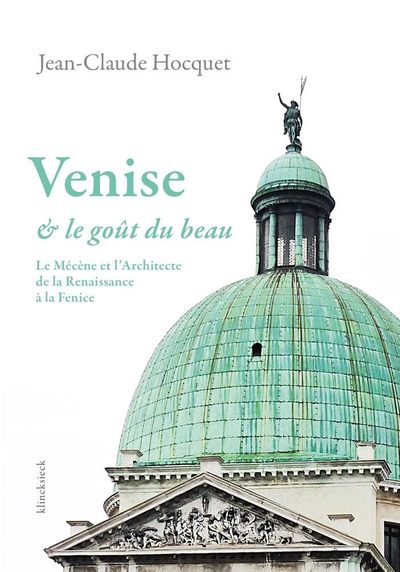
Venise et le goût du beau
Klincksieck - EAN : 9782252039663
Édition papier
EAN : 9782252039663
Paru le : 11 juin 2015
45,00 €
42,65 €
Disponible
Pour connaître votre prix et commander, identifiez-vous
Notre engagement qualité
-
 Livraison gratuite
en France sans minimum
de commande -
 Manquants maintenus
en commande
automatiquement -
 Un interlocuteur
unique pour toutes
vos commandes -
 Toutes les licences
numériques du marché
au tarif éditeur -
 Assistance téléphonique
personalisée sur le
numérique -
 Service client
Du Lundi au vendredi
de 9h à 18h
- EAN13 : 9782252039663
- Editeur : Klincksieck
- Date Parution : 11 juin 2015
- Disponibilite : Disponible
- Barème de remise : NS
- Nombre de pages : 400
- Format : H:215 mm L:150 mm E:1 mm
- Poids : 901gr
- Interdit de retour : Retour interdit
-
Résumé :
Venetian historian Jean-Claude Hocquet, who has penned numerous works on La Serenissima, sheds new light on the city and its history, which he approaches through the prism of the city's art and the societal history of the relations between the noble art patrons or wealthy bourgeois and the creators.
The palaces show how wealth passed from the hands of the old nobility enriched by foreign trade into those of an industrious bourgeoisie who dreamed of imitating their predecessors. Venetian architectures are reflected in the city's omnipresent water, the churches and their domes form a crown around the San Marco Basin, palaces border the world's most beautiful avenue, the Grand Canal and incredibly vast squares.
It took one thousand years for the city to be built and its long history endowed it with the diversity responsible for most of its incomparable beauty and appeal. In the 15th-century Renaissance (the famous Italian Quattrocento), architects and their commissioners were becoming well-known and the Republic's history culminated in the construction of La Fenice, an opera house, in the final years of the Age of Enlightenment.
The book spans these four centuries and retraces the life and works of architects who had come from Florence, Rome or the Venetian state's provinces, often as simple stone cutters trained in their illustrious predecessors' workshops, or theorists well-read in the works of Vitruvius, who, in the Baroque era, built the churches, hospitals, palaces, plain and functional commercial and administrative buildings, as well as the grave markers or temples dedicated to music (the Pietà) or to glorifying heroes.
Its architecture, enriched by painting, sculpture and later to music, transformed Venice into the goddess of the arts.
Jean-Claude Hocquet, who holds an agrégation in History and a PhD, has taught in universities in Paris (Sorbonne), Venice and Lille, as well as at the CNRS and later the EHESS. With Les Belles Lettres, he has published Venise au Moyen Âge (2003, rpt. 2005), Venise, guide culturel d'une ville d'art. De la Renaissance à nos jours (2010), Venise et le monopole du sel. Production, commerce et finance d'une République marchande (2012), to which should be added Venise et la mer, XIIe-XVIIIe siècles (2006). He collaborated on many volumes of the Storia di Venezia published by Enciclopedia Italiana in Rome.
-
Biographie :
Jean-Claude Hocquet est historien, professeur à l'université de Lille III et directeur de recherche au CNRS. Amoureux de Venise, où il se rend tous les ans, il en est un éminent spécialiste. Aux Belles Lettres, il a publié Venise au Moyen Âge (Guide Belles Lettres des civilisations, 2003), Venise. Guide culturel d'une ville d'art de la Renaissance à nos jours (2010) et Venise et le monopole du sel - Tomes I & II. Production, commerce et finance d'une République marchande (2012).