Nous utilisons des cookies pour améliorer votre expérience. Pour nous conformer à la nouvelle directive sur la vie privée, nous devons demander votre consentement à l’utilisation de ces cookies. En savoir plus.

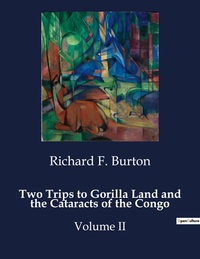
TWO TRIPS TO GORILLA LAND AND THE CATARACTS OF THE CONGO
EAN : 9791041982691

Édition papier
EAN : 9791041982691
Paru le : 23 janv. 2024
18,90 €
17,91 €
Disponible
Pour connaître votre prix et commander, identifiez-vous
Notre engagement qualité
-
 Livraison gratuite
en France sans minimum
de commande -
 Manquants maintenus
en commande
automatiquement -
 Un interlocuteur
unique pour toutes
vos commandes -
 Toutes les licences
numériques du marché
au tarif éditeur -
 Assistance téléphonique
personalisée sur le
numérique -
 Service client
Du Lundi au vendredi
de 9h à 18h
- EAN13 : 9791041982691
- Réf. fournisseur : 330244
- Date Parution : 23 janv. 2024
- Disponibilite : Disponible
- Barème de remise : NS
- Nombre de pages : 166
- Format : H:220 mm L:170 mm E:12 mm
- Poids : 300gr
- Résumé : "Two Trips to Gorilla Land and the Cataracts of the Congo, Volume 2" by Richard F. Burton is a detailed account of the author's explorations in Central Africa during the mid-19th century. The narrative begins with Burton's departure from the island of Fernando Po, where he describes the harsh climate and the prevalence of diseases like yellow fever. He then embarks on a journey aboard the H.M. Steamship "Torch," traveling along the coast of Africa and documenting the geographical and cultural landscapes he encounters. Burton provides vivid descriptions of the Loango Coast, highlighting the natural beauty and the challenges posed by the environment. He also discusses the German expedition's efforts to explore the region and establish a station at Chinxoxo, emphasizing the scientific and commercial interests driving European exploration in Africa. The text further delves into Burton's experiences in São Paulo de Loanda, the capital of Angola, where he observes the social and economic conditions of the Portuguese colony. He notes the decline in trade following the abolition of the slave trade and the change in European influence on local customs and governance. Burton's account is rich with observations on the flora, fauna, and indigenous peoples of the region, offering insights into the complexities of colonial interactions and the natural history of Central Africa. His narrative is both a travelogue and an ethnographic study, reflecting the broader themes of exploration, colonialism, and scientific inquiry during the Victorian era.
- Biographie : Burton was born in Torquay, Devon, at 21:30 on 19 March 1821; in his autobiography, he incorrectly claimed to have been born in the family home at Barham House in Elstree in Hertfordshire. He was baptised on 2 September 1821 at Elstree Church in Borehamwood, Hertfordshire. His father, Lt.-Colonel Joseph Netterville Burton, of the 36th Regiment, was an Irish-born British army officer of Anglo-Irish extraction who through his mother's family—the Campbells of Tuam—was a first cousin of Lt.-Colonel Henry Peard Driscoll and Mrs Richard Graves. Richard's mother, Martha Baker, was the daughter and co-heiress of a wealthy English squire, Richard Baker (1762-1824), of Barham House, Hertfordshire, for whom he was named. Burton had two siblings, Maria Katherine Elizabeth Burton (who married Lt.-General Sir Henry William Stisted) and Edward Joseph Netterville Burton, born in 1823 and 1824, respectively.