Nous utilisons des cookies pour améliorer votre expérience. Pour nous conformer à la nouvelle directive sur la vie privée, nous devons demander votre consentement à l’utilisation de ces cookies. En savoir plus.

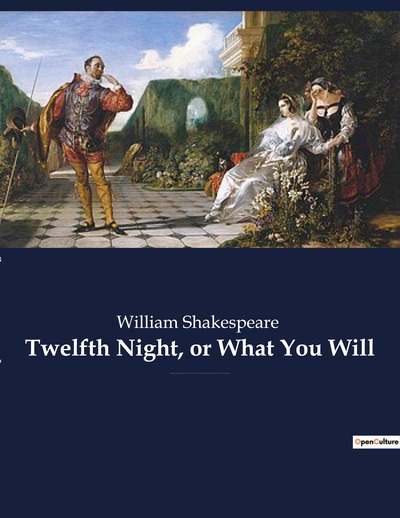
Twelfth Night, or What You Will
EAN : 9782382743768
Édition papier
EAN : 9782382743768
Paru le : 2 mai 2022
19,90 €
18,86 €
Disponible
Pour connaître votre prix et commander, identifiez-vous
Notre engagement qualité
-
 Livraison gratuite
en France sans minimum
de commande -
 Manquants maintenus
en commande
automatiquement -
 Un interlocuteur
unique pour toutes
vos commandes -
 Toutes les licences
numériques du marché
au tarif éditeur -
 Assistance téléphonique
personalisée sur le
numérique -
 Service client
Du Lundi au vendredi
de 9h à 18h
- EAN13 : 9782382743768
- Réf. fournisseur : 233018
- Date Parution : 2 mai 2022
- Disponibilite : Disponible
- Barème de remise : NS
- Nombre de pages : 102
- Format : H:220 mm L:170 mm E:6 mm
- Poids : 173gr
- Résumé : Music opens the play and the Duke asks for more, letting the first scene settle into a mood of longing that belongs to Orsino before any other voice can interrupt it. His thoughts stay fixed on Olivia, who has withdrawn into mourning and refuses to be seen. Even here, Shakespeare sets up desire as something spoken aloud, measured by song, and already liable to misread itself in the palace air. Orsino's court is introduced through music, servants, and the language of desire, so the palace feels busy with private feeling rather than ceremony alone. The Duke's lines move from pleasure in song to impatience with repetition, and that quick turn gives the opening its restless rhythm while keeping Olivia at the center of his speech. Olivia's house appears as a place governed by grief and distance. Valentine reports that she will not show her face for seven years, and that choice gives her household a sealed, withdrawn quality. Her refusal is not simply social reserve but a sign of mourning that shapes every message sent toward her. The sea coast brings Viola into Illyria after the shipwreck, with the captain as her first guide in this strange country. Her first question is practical and immediate, and the shore scene matters because it places her alone, separated from her brother, and forced to speak about survival before she can speak about love. Viola's decision to dress as a young man gives the opening its first clear instance of hidden identity. She chooses the name Cesario so she can enter Orsino's service, and that choice turns appearance into a form of speech. The disguise is not decorative, since it changes who may speak, listen, and be trusted. Orsino's declarations are already moving by messenger, and Viola becomes the voice that carries them toward Olivia. The opening scenes show how letters and errands can alter feeling as they pass from one hand to another. What is meant as admiration becomes, through delivery and timing, something more difficult to read clearly. The comic world begins to gather around Sir Toby Belch, Sir Andrew Aguecheek, Maria, and Feste. Their names alone suggest different tones, and the dossier presents them as a circle of drink, wit, song, and practical mischief. They give the house a lighter but sharper current, where speech can tease, flatter, or unsettle. Malvolio enters this opening frame as Olivia's steward, marked by order, rank, and self-regard. His attachment to propriety gives the household another register, since his presence makes the play attentive to manners, social position, and ridicule. He stands apart from the comic noise, yet he is tied to it by the same domestic setting. Letters and errands drive the action forward, since Orsino's words pass through Viola before they reach Olivia, and meaning changes with every hand that carries it. Malvolio's concern for order and respectability gives the household another tone, since his presence sharpens the play's interest in rank, self-image, and ridicule. Comic energy gathers around Sir Toby, Sir Andrew, Maria, and Feste, whose jokes, songs, and schemes unsettle the household and keep the play in motion. For a reader drawn to plays where feeling travels through disguises, notes, and mistaken names, this opening offers a clear first step into Shakespeare's comic world. It begins with music in the Duke's palace, moves to the sea coast where Viola arrives, and sets in place the first signals of a story built from private longing and public misreading. The language is lively, the scenes are compact, and every entrance seems ready to change the sense of what has just been said.
- Biographie : William Shakespeare (c. 23 April 1564[b] - 23 April 1616) was an English playwright, poet and actor. He is widely regarded as the greatest writer in the English language and the world's pre-eminent dramatist. He is often called England's national poet and the "Bard of Avon" or simply "the Bard". His extant works, including collaborations, consist of some 39 plays, 154 sonnets, three long narrative poems and a few other verses, some of uncertain authorship. His plays have been translated into every major living language and are performed more often than those of any other playwright. Shakespeare remains arguably the most influential writer in the English language, and his works continue to be studied and reinterpreted.