Nous utilisons des cookies pour améliorer votre expérience. Pour nous conformer à la nouvelle directive sur la vie privée, nous devons demander votre consentement à l’utilisation de ces cookies. En savoir plus.

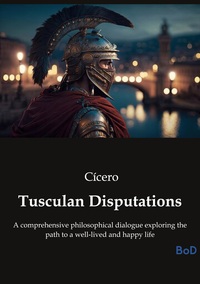
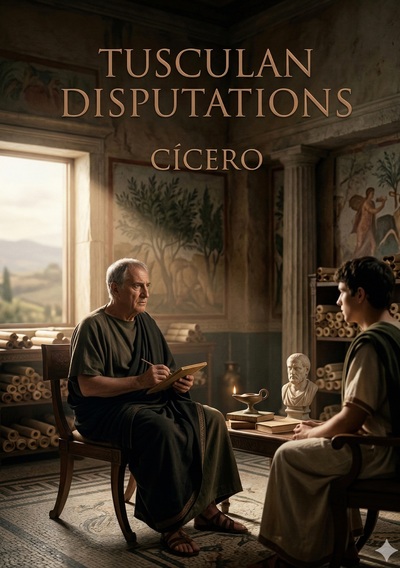
Tusculan Disputations
EAN : 9791043146282
Édition papier
EAN : 9791043146282
Paru le : 2 mars 2026
24,95 €
23,65 €
Disponible
Pour connaître votre prix et commander, identifiez-vous
Notre engagement qualité
-
 Livraison gratuite
en France sans minimum
de commande -
 Manquants maintenus
en commande
automatiquement -
 Un interlocuteur
unique pour toutes
vos commandes -
 Toutes les licences
numériques du marché
au tarif éditeur -
 Assistance téléphonique
personalisée sur le
numérique -
 Service client
Du Lundi au vendredi
de 9h à 18h
- EAN13 : 9791043146282
- Réf. fournisseur : 442643
- Date Parution : 2 mars 2026
- Disponibilite : Disponible
- Barème de remise : NS
- Nombre de pages : 290
- Format : H:210 mm L:148 mm E:16 mm
- Poids : 379gr
- Résumé : Cicero composed these discourses while in his villa in Tusculum as he was mourning the death of his daughter, in order to convey his philosophy of how to live wisely and well. They take the form of fictional dialogues between Cicero and his friends, with each one focusing on a particular Stoic theme. The first, "On the Contempt of Death," reminds us that mortality is nothing to be upset about. The second, "On Bearing Pain," reassures us that philosophy is a balm for pains of the body. The third and fourth, "On Grief of Mind" and "Other Perturbations of the Mind," say that this extends also to mental anguish and unrest. The last, "Whether Virtue Alone Be Sufficient for a Happy Life," tells us that the key to happiness is already in our hands: it is not to rely on accidents of fate, but on our own efforts in areas of life that are under our own control.
- Biographie : Marcus Tullius Cicero[a] (/ˈsɪsəroʊ/ SISS-ə-roh; Latin: [ˈmaːrkus ˈtulli.us ˈkikɛrɔː]; 3 January 106 BC - 7 December 43 BC) was a Roman statesman, lawyer, scholar, philosopher, orator, writer and Academic skeptic,[4] who tried to uphold optimate principles during the political crises that led to the establishment of the Roman Empire.[5] His extensive writings include treatises on rhetoric, philosophy and politics. He is considered one of Rome's greatest orators and prose stylists and the innovator of what became known as "Ciceronian rhetoric".[6][7][8] Cicero was educated in Rome and in Greece. He came from a wealthy municipal family of the Roman equestrian order, and served as consul in 63 BC. He greatly influenced both ancient and modern reception of the Latin language. A substantial part of his work has survived, and he was admired by both ancient and modern authors alike.[9][10][11] Cicero adapted the arguments of the chief schools of Hellenistic philosophy in Latin and coined a large portion of Latin philosophical vocabulary via lexical innovation (e.g. neologisms such as evidentia,[12] generator, humanitas, infinitio, qualitas, quantitas),[13] almost 150 of which were the result of translating Greek philosophical terms.[14] Though he was an accomplished orator and successful lawyer, Cicero believed his political career was his most important achievement. During his consulship in 63 BC, he suppressed the Catilinarian conspiracy. However, because he had summarily and controversially executed five of the conspirators without trial, he was exiled in 58 but recalled the next year. Spending much of the 50s unhappy with the state of Roman politics, he took a governorship in Cilicia in 51 and returned to Italy on the eve of Caesar's civil war. Supporting Pompey during the war, Cicero was pardoned after Caesar's victory. After Caesar's assassination in 44 BC, he led the Senate against Mark Antony, attacking him in a series of speeches. He elevated Caesar's heir Octavian to rally support against Antony in the ensuing violent conflict. But after Octavian and Antony reconciled to form the triumvirate (with Lepidus), Cicero was proscribed and executed in late 43 BC while attempting to escape Italy for safety. His severed hands and head (taken by order of Antony and displayed representing the repercussions of his anti-Antonian actions as a writer and as an orator, respectively) were then displayed on the rostra.[15] Petrarch's rediscovery of Cicero's letters is often credited for initiating the 14th-century Renaissance in public affairs, humanism, and classical Roman culture.[16] According to Polish historian Tadeusz Zieliński, "the Renaissance was above all things a revival of Cicero, and only after him and through him of the rest of Classical antiquity."[17] The peak of Cicero's authority and prestige came during the 18th-century Enlightenment,[18] and his impact on leading Enlightenment thinkers and political theorists such as John Locke, David Hume, Montesquieu, and Edmund Burke was substantial.[19] His works rank among the most influential in global culture, and today still constitute one of the most important bodies of primary material for the writing and revision of Roman history, especially the last days of the Roman Republic