Nous utilisons des cookies pour améliorer votre expérience. Pour nous conformer à la nouvelle directive sur la vie privée, nous devons demander votre consentement à l’utilisation de ces cookies. En savoir plus.

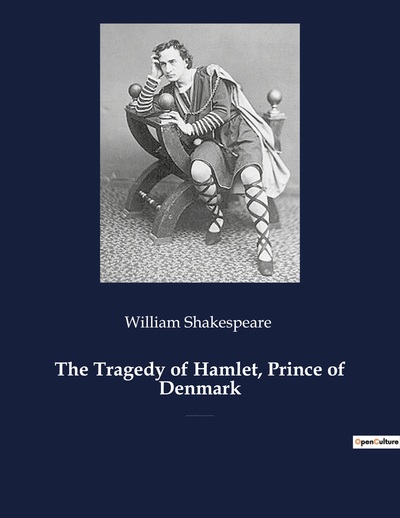
The Tragedy of Hamlet, Prince of Denmark
EAN : 9782382745120
Édition papier
EAN : 9782382745120
Paru le : 3 mai 2022
19,90 €
18,86 €
Disponible
Pour connaître votre prix et commander, identifiez-vous
Notre engagement qualité
-
 Livraison gratuite
en France sans minimum
de commande -
 Manquants maintenus
en commande
automatiquement -
 Un interlocuteur
unique pour toutes
vos commandes -
 Toutes les licences
numériques du marché
au tarif éditeur -
 Assistance téléphonique
personalisée sur le
numérique -
 Service client
Du Lundi au vendredi
de 9h à 18h
- EAN13 : 9782382745120
- Réf. fournisseur : 233029
- Date Parution : 3 mai 2022
- Disponibilite : Disponible
- Barème de remise : NS
- Nombre de pages : 170
- Format : H:220 mm L:170 mm E:10 mm
- Poids : 275gr
- Résumé : The play begins on the night platform at Elsinore, where Francisco and Bernardo trade the watch in the cold and hear the first sign that the castle is not at ease. That opening exchange matters because it places uncertainty inside ordinary duty. Denmark is already grieving its dead king, and the new reign has begun before anyone can settle into it. Shakespeare lets the tension arrive through short questions, a posted guard, and the uneasy claim that something has returned again after midnight. Elsinore is more than a setting, because the castle frames every sound, corridor, and guarded doorway as part of the drama. In the first scene, Francisco stands his post, Bernardo arrives on time, and Horatio and Marcellus hurry toward the platform when they hear that the night has produced another strange report. The concrete detail is simple and memorable. A soldier relieved from watch speaks of bitter cold and a troubled heart, and that private unease matches the wider unease around the walls of the fortress. The Ghost changes the direction of the story by making mourning answerable to memory and command. Its appearance does not close the play's uncertainty, but it gives Hamlet a burden tied to what has been lost and what may still be owed. A concrete example is the nocturnal encounter itself, when the feared figure is also a speaker and the night watch becomes a place where private loss meets a demand that cannot be ignored. From there, the drama moves under the sign of revenge, doubt, and troubled knowledge. Surveillance shapes the story from the start. Rosencrantz and Guildenstern are brought in from among Hamlet's acquaintances, while messengers, officers, and court attendants keep watch on movement and speech. The example is the atmosphere itself: conversations in Elsinore are rarely private, and even a greeting on the platform can sound like an inquiry. The play uses that habit of watching to make ordinary meetings feel unstable. The Ghost turns mourning into a command, and the father's appearance changes the direction of the drama without ending its uncertainty. In the opening scenes, that figure gives Hamlet a burden tied to memory, justice, and what must be done next. The concrete example is the nighttime encounter itself, where a sight that should belong to fear also carries speech, and where the familiar order of the court no longer feels secure. Family conflict enters the play through Hamlet's relation to his parents and to Ophelia, Laertes, and Polonius. One concrete scene of tension lies in the household of Polonius, where father and son speak, and where Ophelia is drawn into warnings and watching. Around these figures, affection, control, and suspicion begin to press on every bond, making personal speech feel exposed even before larger actions begin. Hamlet's inner life forms one of the strongest threads in the opening movement. He is not only grieving but thinking aloud, and the text gives him speeches that slow the action so that thought can unfold in words. A striking example is the way he reflects on duty, truth, and appearance before the court has settled into its new shape. His mind becomes a place where memory and judgment keep crossing paths. If you are searching for Hamlet, Prince of Denmark, this edition offers the full text in a compact volume and lets Elsinore, the watch, the court, and the Ghost appear from the first pages. The opening scenes already gather grief, duty, public ceremony, and private doubt into one charged space. Read it for the language, the pressure of observation, and the courtly world where every word seems to carry more than one meaning.
- Biographie : William Shakespeare (c. 23 April 1564[b] - 23 April 1616) was an English playwright, poet and actor. He is widely regarded as the greatest writer in the English language and the world's pre-eminent dramatist. He is often called England's national poet and the "Bard of Avon" or simply "the Bard". His extant works, including collaborations, consist of some 39 plays, 154 sonnets, three long narrative poems and a few other verses, some of uncertain authorship. His plays have been translated into every major living language and are performed more often than those of any other playwright. Shakespeare remains arguably the most influential writer in the English language, and his works continue to be studied and reinterpreted.