Nous utilisons des cookies pour améliorer votre expérience. Pour nous conformer à la nouvelle directive sur la vie privée, nous devons demander votre consentement à l’utilisation de ces cookies. En savoir plus.

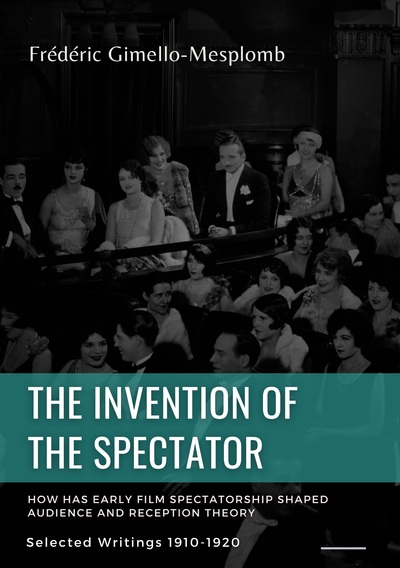
The Invention of the Spectator. How has Early film Spectatorship shaped Audience and Reception Theory
Books On Demand - EAN : 9782322541638
Édition papier
EAN : 9782322541638
Paru le : 24 mars 2026
21,00 €
19,91 €
Disponible
Pour connaître votre prix et commander, identifiez-vous
Notre engagement qualité
-
 Livraison gratuite
en France sans minimum
de commande -
 Manquants maintenus
en commande
automatiquement -
 Un interlocuteur
unique pour toutes
vos commandes -
 Toutes les licences
numériques du marché
au tarif éditeur -
 Assistance téléphonique
personalisée sur le
numérique -
 Service client
Du Lundi au vendredi
de 9h à 18h
- EAN13 : 9782322541638
- Réf. fournisseur : 445007
- Editeur : Books On Demand
- Date Parution : 24 mars 2026
- Disponibilite : Disponible
- Barème de remise : NS
- Nombre de pages : 228
- Format : H:210 mm L:148 mm E:16 mm
- Poids : 337gr
- Résumé : Spectatorship Before Theory : A Revisited History of Early Cinema Audience Studies (1900-1915) This monograph reconstructs the intellectual genealogy of audience theory, shifting the historiographical focus to the often-overlooked decades preceding the Weimar period (pre-Kracauer). It contests the prevailing academic narrative that reduces pre-1920s cinema inquiries to mere quantitative demographics or moral surveillance. Instead, the text demonstrates that the years 1900-1915 generated a sophisticated, albeit fragmented, body of theoretical work regarding the social and psychological dimensions of moviegoing. Embedded within the structural shifts of industrial modernity, capitalism, and metropolitan growth, the analysis identifies how early scholars conceptualized the cinema as a primary agent of cultural production. The book aggregates disparate sources from psychology, sociology, and urban studies to reveal a coherent discourse on spectatorship. It argues that these initial observers identified the audience not as a passive mass, but as a collective engaged in active cultural negotiation and psychological processing. By retrieving these archival sources, Frédéric Gimello-Mesplomb maps the transition from initial curiosity to systematic academic inquiry. It provides a detailed account of how the "moving picture" was understood as a vector for social interaction and consciousness formation long before the canonization of classical film theory. This study offers a revised timeline for the discipline, locating the origins of reception studies in the immediate friction between early audiences and the screen.
- Biographie : Frédéric Gimello-Mesplomb is Professor of Media & Cultural Studies at the University of Avignon, France and researcher in the Audiovisuel Research Lab at the University of Toulouse - Jean Jaurès. A former Visiting Scholar at the University of California, Berkeley, and former faculty member of the Academy of Television Arts & Sciences (Emmy Awards) in Hollywood, he brings an international perspective to his research on media economics, and film policy. He is the author of numerous scholarly works on French cinema, French Cultural policy and Film Music.