Nous utilisons des cookies pour améliorer votre expérience. Pour nous conformer à la nouvelle directive sur la vie privée, nous devons demander votre consentement à l’utilisation de ces cookies. En savoir plus.

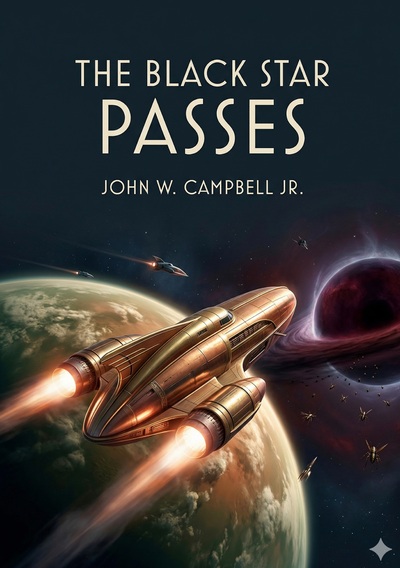
The Black Star Passes
EAN : 9791043143618
Édition papier
EAN : 9791043143618
Paru le : 25 mars 2026
22,00 €
20,85 €
Disponible
Pour connaître votre prix et commander, identifiez-vous
Notre engagement qualité
-
 Livraison gratuite
en France sans minimum
de commande -
 Manquants maintenus
en commande
automatiquement -
 Un interlocuteur
unique pour toutes
vos commandes -
 Toutes les licences
numériques du marché
au tarif éditeur -
 Assistance téléphonique
personalisée sur le
numérique -
 Service client
Du Lundi au vendredi
de 9h à 18h
- EAN13 : 9791043143618
- Réf. fournisseur : 448533
- Date Parution : 25 mars 2026
- Disponibilite : Disponible
- Barème de remise : NS
- Nombre de pages : 274
- Format : H:210 mm L:148 mm E:15 mm
- Poids : 359gr
- Résumé : In the year 2126, scientists Arcot and Morey chase a sky pirate—and invent the technology to travel through space. In the second story, the heroes travel to Venus and make first contact with an alien species. Finally, they must defend the solar system from invaders whose own star has long since gone dark.Originally published separately as "Piracy Preferred" in Amazing Stories June 1930 edition, "Solarite" in Amazing Stories November 1930, and "The Black Star Passes" in Amazing Stories Quarterly Fall 1930, these three novellas were edited and collected into this volume in 1953.This is the first book in John W. Campbell's Arcot, Morey, and Wade trilogy. Most famous for editing Astounding Science Fiction and Fact magazine and introducing Isaac Asimov, Robert Heinlein, and many other great science fiction authors to the world, Campbell's other notable works include the novella "Who Goes There?", which was adapted to film as The Thing by John Carpenter in 1982.
- Biographie : John Campbell was born in Newark, New Jersey, in 1910. His father, John Wood Campbell Sr., was an electrical engineer. His mother, Dorothy (née Strahern) had an identical twin who visited them often and who disliked John. John was unable to tell them apart and says he was frequently rebuffed by the person he took to be his mother. Campbell attended the Blair Academy, a boarding school in rural Warren County, New Jersey, but did not graduate because of lack of credits for French and trigonometry. He also attended, without graduating, the Massachusetts Institute of Technology (MIT), where he was befriended by the mathematician Norbert Wiener (who coined the term cybernetics) - but he failed German, and MIT dismissed him in his junior year in 1931. After two years at Duke University, he graduated with a Bachelor of Science in physics in 1934.