Nous utilisons des cookies pour améliorer votre expérience. Pour nous conformer à la nouvelle directive sur la vie privée, nous devons demander votre consentement à l’utilisation de ces cookies. En savoir plus.

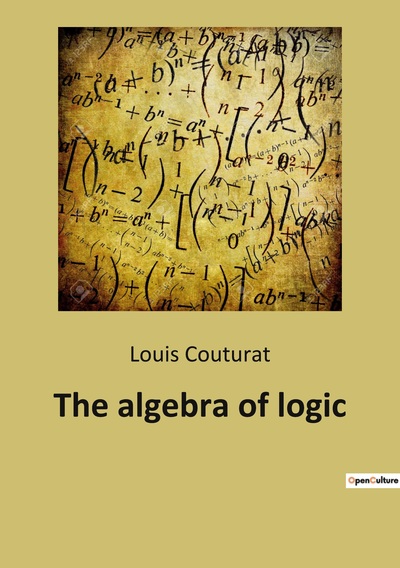
The algebra of logic
EAN : 9791041940806
Édition papier
EAN : 9791041940806
Paru le : 15 déc. 2022
14,00 €
13,27 €
Disponible
Pour connaître votre prix et commander, identifiez-vous
Notre engagement qualité
-
 Livraison gratuite
en France sans minimum
de commande -
 Manquants maintenus
en commande
automatiquement -
 Un interlocuteur
unique pour toutes
vos commandes -
 Toutes les licences
numériques du marché
au tarif éditeur -
 Assistance téléphonique
personalisée sur le
numérique -
 Service client
Du Lundi au vendredi
de 9h à 18h
- EAN13 : 9791041940806
- Réf. fournisseur : 256799
- Date Parution : 15 déc. 2022
- Disponibilite : Disponible
- Barème de remise : NS
- Nombre de pages : 94
- Format : H:210 mm L:148 mm E:7 mm
- Poids : 149gr
- Résumé : Louis Couturat (French: [kutyʁa]; 17 January 1868 - 3 August 1914) was a French logician, mathematician, philosopher, and linguist. Couturat was a pioneer of the constructed language Ido. He was the French advocate of the symbolic logic that emerged in the years before World War I, thanks to the writings of Charles Sanders Peirce, Giuseppe Peano and his school, and especially to The Principles of Mathematics by Couturat's friend and correspondent Bertrand Russell. Like Russell, Couturat saw symbolic logic as a tool to advance both mathematics and the philosophy of mathematics. In this, he was opposed by Henri Poincaré, who took considerable exception to Couturat's efforts to interest the French in symbolic logic. With the benefit of hindsight, we can see that Couturat was in broad agreement with the logicism of Russell, while Poincaré anticipated Brouwer's intuitionism. His first major publication was Couturat (1896). In 1901, he published La Logique de Leibniz, a detailed study of Leibniz the logician, based on his examination of the huge Leibniz Nachlass in Hanover. Even though Leibniz had died in 1716, his Nachlass was cataloged only in 1895. Only then was it possible to determine the extent of Leibniz's unpublished work on logic. In 1903, Couturat published much of that work in another large volume, his Opuscules et Fragments Inedits de Leibniz, containing many of the documents he had examined while writing La Logique. Couturat was thus the first to appreciate that Leibniz was the greatest logician during the more than 2000 years that separate Aristotle from George Boole and Augustus De Morgan. A significant part of the 20th century Leibniz revival is grounded in Couturat's editorial and exegetical efforts. This work on Leibniz attracted Russell, also the author of a 1900 book on Leibniz, and thus began their professional correspondence and friendship. In 1905, Couturat published a work on logic and the foundations of mathematics (with an appendix on Kant's philosophy of mathematics) that was originally conceived as a translation of Russell's Principles of Mathematics. In the same year, he published L'Algèbre de la logique, a classic introduction to Boolean algebra and the works of C.S. Peirce and Ernst Schröder.