Nous utilisons des cookies pour améliorer votre expérience. Pour nous conformer à la nouvelle directive sur la vie privée, nous devons demander votre consentement à l’utilisation de ces cookies. En savoir plus.

The Aircraft Electrical Power Distribution Handbook
Cepadues - EAN : 9782383953098
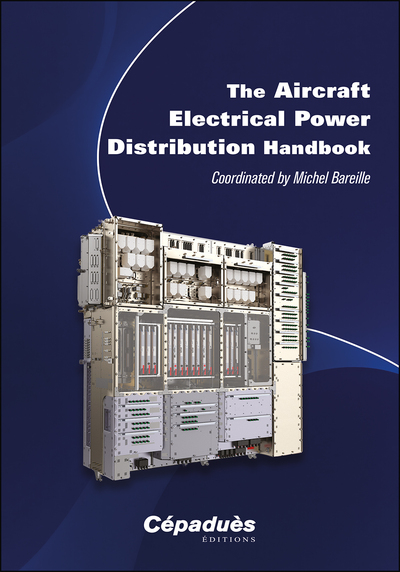
Édition papier
EAN : 9782383953098
Paru le : 11 août 2026
50,00 €
47,39 €
Disponible
Pour connaître votre prix et commander, identifiez-vous
Notre engagement qualité
-
 Livraison gratuite
en France sans minimum
de commande -
 Manquants maintenus
en commande
automatiquement -
 Un interlocuteur
unique pour toutes
vos commandes -
 Toutes les licences
numériques du marché
au tarif éditeur -
 Assistance téléphonique
personalisée sur le
numérique -
 Service client
Du Lundi au vendredi
de 9h à 18h
- EAN13 : 9782383953098
- Réf. fournisseur : 2309
- Editeur : Cepadues
- Date Parution : 11 août 2026
- Disponibilite : Disponible
- Barème de remise : NS
- Nombre de pages : 574
- Format : H:240 mm L:160 mm E:26 mm
- Poids : 1.015kg
-
Résumé :
Electrification is a deep and long-lasting trend in the aircraft industry. It began during the First World War with engine ignition and wireless telegraphy in military aircraft. At that time, the voltage system was 6VDC or 12VDC. After the Second World War, aircraft size and speed increase required more power to supply all the loads. Due to its better reliability and power density, AC generation established itself as a supplement to the DC one and constant speed 115VAC/400Hz generators became the standard for commercial aircraft. Today, the AIRBUS A350 and the BOEING B787 are powered by 230VAC/100kVA by 230VAC/250kVA generators respectively. Tomorrow, with the planned suppression of pneumatic and hydraulic networks, onboard power is likely to exceed 1MW, and even more in the case of hybrid or full electric propulsion, for a supply voltage of around 1kVDC.
At the heart of electrical architectures, the distribution system holds a leading role. Besides connecting sources to loads, it handles crucial functions for the airplane, like devices protection against electrical hazards or network reconfiguration after a source failure.
There is little literature describing what an aircraft electrical distribution system is. That is why the authors have undertaken to capitalize all their knowledge about it in this work. The topics addressed are centered around the distribution system functions: supply loads, reconfigure the network as per sources availability, monitor and guarantee the network integrity, communicate with other aircraft controllers, inform about its status. These functions are detailed in different chapters with elements of the technologies used to implement them. The distribution system itself is presented in a dedicated section. This book ends with design considerations about Power Distribution Units: electrical installation, lightning strike protection, bonding/grounding, corrosion, mechanical and thermal design.
It was written for “self-starter” electrical engineers but also for those who want to upgrade their knowledge in that domain. It does not provide the level of detail that can be found in design notes or maintenance manuals but rather gives information helping the reader understand the current and future stakes of electrical distribution in civil aviation. It will also be of help to electrical engineering or aeronautics students who would like to specialize in this field.
Sommaire
1. Introduction
2. EPDS loads supply function
3. EPDS protection function
4. EPDS network supervision function
5. EPDS communication function
6. EPDS presentation and status
8. Power Distribution Units mechanical and thermal design
Index