Nous utilisons des cookies pour améliorer votre expérience. Pour nous conformer à la nouvelle directive sur la vie privée, nous devons demander votre consentement à l’utilisation de ces cookies. En savoir plus.

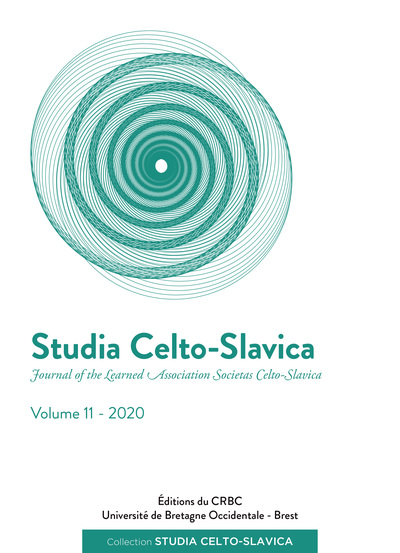
Studia Celto-Slavica 11
EAN : 9791092331530
Édition papier
EAN : 9791092331530
Paru le : 1 sept. 2020
15,00 €
14,22 €
Disponible
Pour connaître votre prix et commander, identifiez-vous
Notre engagement qualité
-
 Livraison gratuite
en France sans minimum
de commande -
 Manquants maintenus
en commande
automatiquement -
 Un interlocuteur
unique pour toutes
vos commandes -
 Toutes les licences
numériques du marché
au tarif éditeur -
 Assistance téléphonique
personalisée sur le
numérique -
 Service client
Du Lundi au vendredi
de 9h à 18h
- EAN13 : 9791092331530
- Collection : SCS
- Date Parution : 1 sept. 2020
- Disponibilite : Disponible
- Barème de remise : NS
- Nombre de pages : 132
- Format : H:170 mm L:235 mm
- Poids : 401gr
- Interdit de retour : Retour interdit
- Résumé : The volume contains the first part of proceedings of the 9th International Colloquium of Societas Celto-Slavica held at the University of Western Brittany’s Quimper campus between 23-24 June 2018, including the colloquium summary by G. Manchec-German and M. Fomin (‘Introduction’). P. Galliou (‘Between East and West: Armorica and the European Bronze and Iron Ages’) argues that the Armorican peninsula was fully involved during the Bronze and Iron ages in the cultural mutations occurring in western and continental communities which resulted in the development of new technological and artistic expressions. Jean Le Dû (‘The Celtic Element in Gallo-Romance Dialect Areas’) argues that the Celtic substratum in the development of the French language has been underestimated. He compares Atlas Linguistique de la France (ALF) maps with Breton ones, using the data recorded in Le Roux’s Atlas Linguistique de la Basse-Bretagne and Le Dû’s Nouvel Atlas Linguistique de la Basse-Bretagne, demonstrating that several of these maps reveal the presence of ALF data whose origin is clearly Celtic. M. Fomin (‘Name-Avoidance and Circumlocutory Terms in Modern Irish and Scottish Maritime Memorates’) and Y. Riou (‘Nautical Toponymy and Fieldwork in Léon, Northwest Brittany’) analyse intangible aspects of the 20th century maritime heritage in Ireland and Scotland on the one hand, and in Brittany, on the other. E. Parina and L. Geinitz (‘Val i may ysgrifenedig: Derivatives with Suffix -edig in Three Early Modern Welsh Texts’) study trends in the usage of edig-derivatives in Gesta Romanorum, Marchog Crwydrad and Perl mewn Adfyd. B. Maier (‘Celtic Correspondences: Letters from Whitley Stokes to Adolphe Pictet and from Henri d’Arbois de Jubainville to Ernst Windisch’) discusses the correspondence between these 19th century Irish, Swiss, French and German Celticists. The collaboration and mutual influences they exerted upon one another contributed to laying the scientific foundations of Celtic Studies as we know it today. This volume is dedicated to the memory of Professor Jean Le Dû who passed away on the morning of May 6, 2020. His obituary is presented by his former doctoral student and friend, G. Manchec-German (‘In Memoriam: †Jean Le Dû (1938-2020)’). †Jean Le Dû / Gary Manchec-German / Patrick Galliou / Yann Riou / Elena Parina / Lara Geinitz / Bernhard Maier / Maxim Fomin