Nous utilisons des cookies pour améliorer votre expérience. Pour nous conformer à la nouvelle directive sur la vie privée, nous devons demander votre consentement à l’utilisation de ces cookies. En savoir plus.

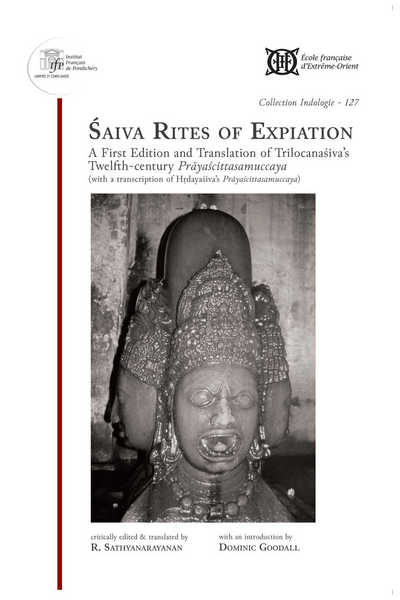
SAIVA RITES OF EXPIATION
Efeo - EAN : 9782855392189
Édition papier
EAN : 9782855392189
Paru le : 19 févr. 2015
52,00 €
49,29 €
Disponible
Pour connaître votre prix et commander, identifiez-vous
Notre engagement qualité
-
 Livraison gratuite
en France sans minimum
de commande -
 Manquants maintenus
en commande
automatiquement -
 Un interlocuteur
unique pour toutes
vos commandes -
 Toutes les licences
numériques du marché
au tarif éditeur -
 Assistance téléphonique
personalisée sur le
numérique -
 Service client
Du Lundi au vendredi
de 9h à 18h
- EAN13 : 9782855392189
- Réf. fournisseur : CI 127
- Collection : COLL.INDOLOGIE
- Editeur : Efeo
- Date Parution : 19 févr. 2015
- Disponibilite : Disponible
- Barème de remise : NS
- Nombre de pages : 651
- Format : H:250 mm L:180 mm E:50 mm
- Poids : 1.35kg
- Interdit de retour : Retour interdit
-
Résumé :
Rites of expiation and reparation (prayascitta) may not seem central to the history of the Mantramarga, but they provide a fascinating angle from which to view the evolution of this broad religious tradition. Instead of focussing on the evolution and philosophical defence of Saiva doctrines, or on the examination of ritual practices and of theories developed to justify and shore up such practices, this study puts the spotlight instead on social dimensions of the religion.
This book contains a first edition and translation of a South Indian compendium of Saiva expiation rituals compiled by Trilocanasiva, a twelfth-century theologian celebrated for his Siddhantasaravali, a metrical treatise on the Saivasiddhanta that is still traditionally studied in the Tamil-speaking South today. Trilocana does not reveal the sources from which he quotes, many of which are lost to us, but an earlier Northern treatise on the same theme from Malwa by a certain Hrdayasiva consists only in large labeled quotations, typically whole chapters, from those sources. A Nepalese alm-leaf manuscript kept in Cambridge that is dated to 1157 AD may be the earliest surviving codex to transmit Hrdayasiva’s text and we have included a complete transcription of that manuscript as an appendix. A combined quarter-verse-index helps readers to navigate both Trilocana’s and Hrdaya&siva’s works.
Our introduction attempts to trace the social developments within the Saivasiddhanta that give context to the evolution of Saiva reparatory rites.
About the Editors
Following studies at the Madras Sanskrit College and the University of Madras, R. Sathyanarayanan joined the Pondicherry Centre of the EFEO in 1991 to work on epigraphy. He obtained his doctorate from Pondicherry University in 2003 for his study of the Anandarangacampu (a romance in prose and verse about the eighteenth-century political diarist Anandaranga Pillai) and has since been working on Saiva literature, notably as co-editor of two other twelfth-century Southern works: the Pañcavaranastava (Pondicherry 2005) and the Dhyanaratnavali (Karaikkal 2014).
After studies in Oxford and in Hamburg, Dominic Goodall passed several years working in Pondicherry, where he was head of the Pondicherry Centre of the École française d’Extrême-Orient from 2002 to 2011. He has published critical editions of Saiva works and of classical Sanskrit poetry (most recently, with Csaba Dezso, the eighthcentury Kuttanimata of Damodaragupta). He is currently based in Paris, where he gives lectures on Indian and Cambodian Sanskrit literature at the École pratique des hautes études (religious science section).