Nous utilisons des cookies pour améliorer votre expérience. Pour nous conformer à la nouvelle directive sur la vie privée, nous devons demander votre consentement à l’utilisation de ces cookies. En savoir plus.

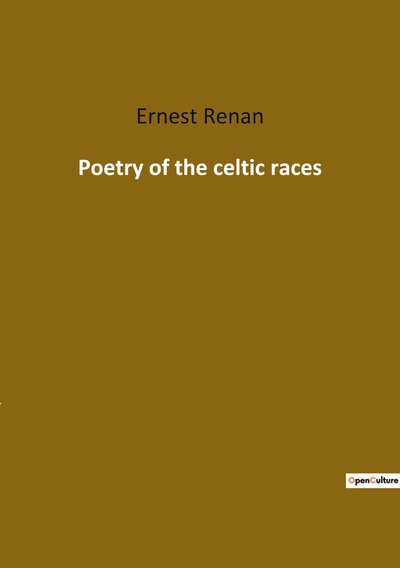
Poetry of the celtic races
EAN : 9782385083588
Édition papier
EAN : 9782385083588
Paru le : 31 août 2022
18,00 €
17,06 €
Disponible
Pour connaître votre prix et commander, identifiez-vous
Notre engagement qualité
-
 Livraison gratuite
en France sans minimum
de commande -
 Manquants maintenus
en commande
automatiquement -
 Un interlocuteur
unique pour toutes
vos commandes -
 Toutes les licences
numériques du marché
au tarif éditeur -
 Assistance téléphonique
personalisée sur le
numérique -
 Service client
Du Lundi au vendredi
de 9h à 18h
- EAN13 : 9782385083588
- Réf. fournisseur : 248032
- Date Parution : 31 août 2022
- Disponibilite : Disponible
- Barème de remise : NS
- Nombre de pages : 66
- Format : H:210 mm L:148 mm E:4 mm
- Poids : 99gr
- Résumé : Ernest Renan was born in 1823, at Tréguier in Brittany. He was educated for the priesthood, but never took orders, turning at first to teaching. He continued his studies in religion and philology, and, after traveling in Syria on a government commission, he returned to Paris and became professor of Hebrew in the Collège de France, from which he was suspended for a time on account of protests against his heretical teachings. He died in 1892. Renan's activity divides itself into two parts. The first culminated in his two great works on the "Origins of Christianity" and on the "History of Israel." As to the scientific value of these books there is difference of opinion, as was to be expected in a treatment of such subjects to the exclusion of the miraculous. But the delicacy and vividness of his portraits of the great personalities of Hebrew history, and the acuteness of his analysis of national psychology, are not to be denied. The other part of his work is more miscellaneous, but most of it is in some sense philosophical or autobiographical. Believing profoundly in scientific method, Renan was unable to find in science a basis for either ethics or metaphysics, and ended in a skepticism often ironical, yet not untinged with mysticism. "He was an amazing writer," says M. Faguet, "and disconcerted criticism by the impossibility of explaining his methods of procedure; he was luminous, supple, naturally pliant and yielding; beneath his apparently effeminate grace an extraordinary strength of character would suddenly make itself felt; he had, more than any nineteenth-century writer, the quality of charm; he exercised a caressing influence which enveloped, and finally conquered, the reader." In no kind of writing was Renan's command of style more notable than in the description of scenery. In his pictures of his native Brittany in the essay on The Poetry of the Celtic Races, as well as in his analysis of national qualities, two of his most characteristic powers are admirably displayed.
- Biographie : Ernest Renan, né le 28 février 18231 à Tréguier (Côtes-du-Nord) et mort le 2 octobre 1892 à Paris, est un écrivain, philologue, philosophe et historien français. Curieux de science, Ernest Renan est immédiatement convaincu par les hypothèses de Darwin sur l'évolution des espèces. Il établit un rapport étroit entre les religions et leurs racines ethnico-géographiques. Une part essentielle de son oeuvre est d'ailleurs consacrée aux religions avec par exemple son Histoire des origines du christianisme (7 volumes de 1863 à 1881) dont le premier tome est consacré à la Vie de Jésus (1863). Ce livre qui marque les milieux intellectuels de son vivant contient la thèse, alors controversée, selon laquelle la biographie de Jésus doit être comprise comme celle de n'importe quel autre homme, et la Bible comme devant être soumise à un examen critique comme n'importe quel autre document historique. Ceci déclenche des débats passionnés et la colère de l'Église catholique. Ernest Renan est considéré aujourd'hui comme un intellectuel de référence avec des textes comme Prière sur l'Acropole (1865) ou Qu'est-ce qu'une nation ? (1882). Son intérêt pour sa Bretagne natale a été également constant de L'Âme bretonne (1854) à son texte autobiographique Souvenirs d'enfance et de jeunesse (1883).