Nous utilisons des cookies pour améliorer votre expérience. Pour nous conformer à la nouvelle directive sur la vie privée, nous devons demander votre consentement à l’utilisation de ces cookies. En savoir plus.

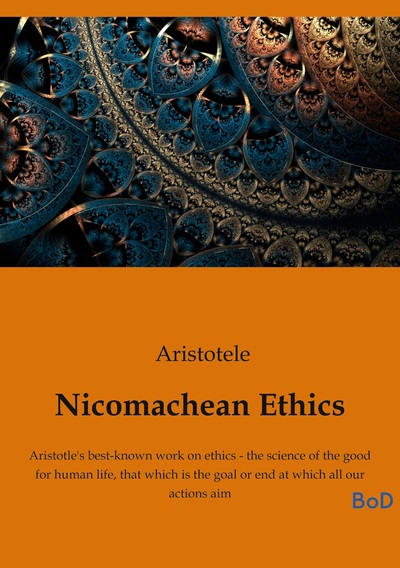
Nicomachean Ethics
EAN : 9791043128530
Édition papier
EAN : 9791043128530
Paru le : 4 févr. 2026
29,90 €
28,34 €
Disponible
Pour connaître votre prix et commander, identifiez-vous
Notre engagement qualité
-
 Livraison gratuite
en France sans minimum
de commande -
 Manquants maintenus
en commande
automatiquement -
 Un interlocuteur
unique pour toutes
vos commandes -
 Toutes les licences
numériques du marché
au tarif éditeur -
 Assistance téléphonique
personalisée sur le
numérique -
 Service client
Du Lundi au vendredi
de 9h à 18h
- EAN13 : 9791043128530
- Réf. fournisseur : 439268
- Date Parution : 4 févr. 2026
- Disponibilite : Disponible
- Barème de remise : NS
- Nombre de pages : 354
- Format : H:210 mm L:148 mm E:19 mm
- Poids : 458gr
- Résumé : Aristotle's Nicomachean Ethics is a foundational work of moral and political philosophy, primarily concerned with defining the highest human good: happiness (eudaimonia). The treatise systematically explores the nature of moral and intellectual virtues, defining moral virtues as a mean between extremes, exemplified by courage, temperance, liberality, and truthfulness. It meticulously examines voluntary and involuntary actions, choice, and deliberation as fundamental to ethical conduct. A significant portion is dedicated to justice, analyzed in its general and particular forms, including distributive and corrective justice, and its relationship to law and equity. The text then delves into intellectual virtues—art, science, prudence, wisdom, and intuitive reason—and their respective functions. Beyond virtues and vices, Aristotle discusses character traits like continence, incontinence, and brutality, addressing the interplay of knowledge, passion, and action. The work also provides an extensive analysis of friendship (philia), exploring its various forms based on utility, pleasure, and character, and its crucial role in human life and political communities. It further investigates the nature of pleasure and its connection to virtue and happiness. Ultimately, happiness is identified with the exercise of intellectual virtue, particularly contemplation, while acknowledging the necessity of external goods. The Ethics concludes by emphasizing the essential role of law and education (legislation) in cultivating virtue and guiding individuals towards a good life, thereby linking ethics directly to political science and the study of the best constitution.