Nous utilisons des cookies pour améliorer votre expérience. Pour nous conformer à la nouvelle directive sur la vie privée, nous devons demander votre consentement à l’utilisation de ces cookies. En savoir plus.

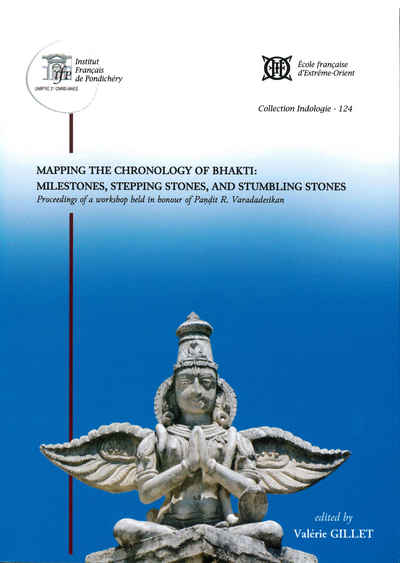
Mapping the Chronology of Bhakti: Milestones, Stepping Stones, and Stumbling Stones
Efeo - EAN : 9782855391380
Édition papier
EAN : 9782855391380
Paru le : 2 juin 2014
48,00 €
45,50 €
Disponible
Pour connaître votre prix et commander, identifiez-vous
Notre engagement qualité
-
 Livraison gratuite
en France sans minimum
de commande -
 Manquants maintenus
en commande
automatiquement -
 Un interlocuteur
unique pour toutes
vos commandes -
 Toutes les licences
numériques du marché
au tarif éditeur -
 Assistance téléphonique
personalisée sur le
numérique -
 Service client
Du Lundi au vendredi
de 9h à 18h
- EAN13 : 9782855391380
- Réf. fournisseur : CI 124
- Collection : COLL.INDOLOGIE
- Editeur : Efeo
- Date Parution : 2 juin 2014
- Disponibilite : Disponible
- Barème de remise : NS
- Nombre de pages : 381
- Format : H:240 mm L:173 mm E:26 mm
- Poids : 900gr
- Interdit de retour : Retour interdit
-
Résumé :
Starting around the sixth century of the common era, a new form of fervent religiosity seems to be discernible in the Tamil-speaking South that is often termed the “Bhakti movement”. The eleven essays gathered in this volume all deal with South Indian primary sources related to the various phenomena that can be grouped together under the head of “Bhakti”, which may be broadly defined as personal devotion between a devotee and his god. What characterized the early phase of this “movement”, which in subsequent centuries swept across the whole sub-continent and transformed popular religion in every place that it reached, was the emphasis placed upon the emotional aspect of the relation between the devotee and his chosen deity: the Tamil hymns regularly underline the message that salvation can be attained just through such devotion.,
The chronology of the appearance, growth and development of this transformative movement is riddled with uncertainties, whether we consider literary or archaeological evidence. Each of the contributions to this volume addresses some aspect of the history of this movement in the South, and so, drawing on a wide range of disciplines — linguistics, philology, epigraphy, archaeology — they together contribute, each in its own way, to the mapping of the chronology of Bhakti. This volume is dedicated to our esteemed colleague Pandit R. Varadadesikan, a specialist of the Tamil sources of Vaisnavism, who recently retired after dedicating forty-four years of his life to a career in the Pondicherry Centre of the EFEO working to further understanding of Tamil and Manipravalam literature.
Contents
Introductory Note (Valérie Gillet)
Biography and Bibliography of Paṇḍit R. Varadadesikan (S.A.S Sarma)
A Note on Time: Venkatanatha’s conception of time (Marcus Schmücker)
Metres in Tamil Bhakti Literature and the Problem of their (occasional)Description in Treatises (Studies in Tamil Metrics-2) (Jean-Luc Chevillard)
Royal and Local Bhakti under the Pallavas (Emmanuel Francis)
Jivakacintamani’s Contribution to Periyapuranam (T.S. Gangadharan)
Tracking Traces of Gods: the site of Tirupparankunram (Valérie Gillet)
The Sacred Landscape of Tamil Saivism: Plotting Place in the Realm of Devotion (Leslie C. Orr)
Life after Death: From Mortal Remains to Monuments (K. Rajan)
The Edifice of Bhakti: towards an “archaeological” reading ofTevaram and Periyapuranam (Charlotte Schmid)
Vaisnava Literature in Tamil (R. Varadadesikan)
From Ancient Poetics to Applied Poetics: Continuance and Change in Tamil Bhakti Poetry (With special reference to Nammalvar’sakam poems) (G. Vijayavenugopal)
Nammalvar as a Master of tinaimayakkam—Transposition Techniques in the akam Songs of the Tiruvaymoḻi (Eva Wilden)
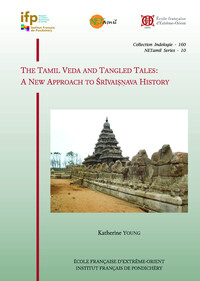
Srivaisnava Topoi: Constructing a South Indian Sect through Place (Katherine Young)
-
Biographie :
About the Editor
Valérie GILLET is a member of the École française d'Extrême-Orient. Her research focuses on material mostly found in the religious monuments excavated or built on the territories of the two main early medieval South Indian dynasties, the Pallavas and the Pandyas. She also attempts to map the emergence and the development of the cult of the deity called Subrahmanya/Murukan in the medieval Tamil-speaking South. Since 2007, she has been posted at the Pondicherry Centre of the EFEO, of which she became Head in 2011. She has published a study of the narrative iconography of the 8th century structural Pallava temples entitled La creation d'une iconographie sivaïte narrative: Incarnations du dieu dans les temples pallava construits, as well as several articles on material from the Pallava period and sacred places related to Subrahmanya/Murukan.