Nous utilisons des cookies pour améliorer votre expérience. Pour nous conformer à la nouvelle directive sur la vie privée, nous devons demander votre consentement à l’utilisation de ces cookies. En savoir plus.

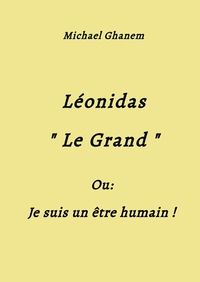
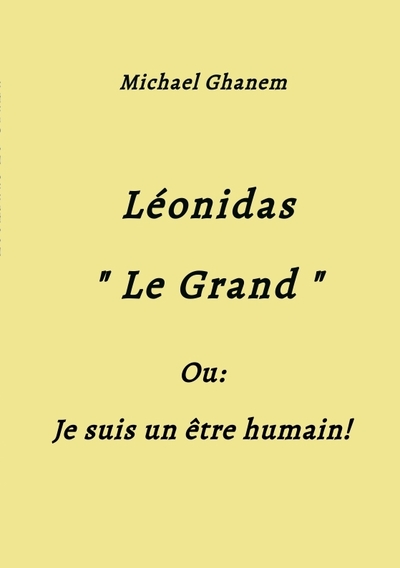
Léonidas Le Grand
Tredition - EAN : 9783384830760
Édition papier
EAN : 9783384830760
Paru le : 19 févr. 2026
15,00 €
14,22 €
Disponible
Pour connaître votre prix et commander, identifiez-vous
Notre engagement qualité
-
 Livraison gratuite
en France sans minimum
de commande -
 Manquants maintenus
en commande
automatiquement -
 Un interlocuteur
unique pour toutes
vos commandes -
 Toutes les licences
numériques du marché
au tarif éditeur -
 Assistance téléphonique
personalisée sur le
numérique -
 Service client
Du Lundi au vendredi
de 9h à 18h
- EAN13 : 9783384830760
- Réf. fournisseur : 440488
- Editeur : Tredition
- Date Parution : 19 févr. 2026
- Disponibilite : Disponible
- Barème de remise : NS
- Nombre de pages : 84
- Format : H:210 mm L:148 mm E:6 mm
- Poids : 135gr
- Résumé : Ce livre rend hommage à une personne qui a été le voisin de l'auteur pendant de nombreuses années. L'auteur l'a appelé Léonidas le Grand dans cet ouvrage. Ce n'était pas son vrai nom, mais il lui allait bien et exprimait le fait qu'il était vraiment quelqu'un d'exceptionnel et de très spécial. Léonidas n'était pas particulièrement séduisant, il avait l'apparence d'un Grec typique, même s'il n'en était pas un. Il n'était ni bruyant ni autoritaire, mais il avait une autorité naturelle et parlait d'une voix douce. Il venait de quelque part de la région méditerranéenne. Il semblait avoir bénéficié d'une éducation et d'une culture de premier ordre, ce qui était certainement le reflet de ses origines nobles. Son destin, que l'auteur a parfois pu partager, ne semblait pas toujours avoir été très heureux, même si les apparences pouvaient laisser penser le contraire. Il avait en fait tout ce qu'on pouvait désirer, il était intelligent et apparemment aussi fortuné. On ne sait pas pourquoi il avait choisi précisément l'Allemagne pour s'y installer. Il n'y a pas trouvé le bonheur. Ce livre pourrait toutefois servir d'avertissement à tous les jeunes qui souhaitent s'installer dans un pays où la superficialité est la principale préoccupation de la société. Mais il pourrait également être utile à ceux qui ont conservé leur foi dans la culture de leurs pères, répandue en Europe du Nord, et leur esprit critique.
- Biographie : Born in 1949, he grew up in France and graduated from an elite French university for industrial engineers. After moving to Germany, he studied economics, sociology, political science, philosophy and ethics. In the field of philosophy, he was strongly influenced by the philosophy and teachings of Zarathustra, Socrates, Plato, Aristotle, Marcus Aurelius, Rabelais, Michel de Montaigne, Baruch Spinoza, Thomas Aquinas, Ibn Khaldun, Niccolo Machiavelli, René Descartes, Blaise Pascal, Voltaire, Jean Jacques Rousseau, Immanuel Kant, Gottfried W. Leibniz, Auguste Comte, Arthur Schopenhauer, Pierre-Joseph Proudhon, Karl Marx, Henri Bergson, Karl Popper, Karl Jaspers, and Erich Fromm. In the field of economics, he was strongly influenced by post-Keynesians and behavioural economists. He is highly critical of the teachings of Milton Friedman, the Chicago Boys, the Frederick School and Friedrich A. Hayek. His professional career first took him to an international organisation, where he worked for five years as a project controller for major water projects, mainly in Africa, and thanks to this, he was able to get to know a large number of countries and their leaders. He then worked for many years for a European organisation and several international consulting firms. He considers himself a critic of current globalisation and has been strongly committed to water management and economics issues since 1974. These experiences have given him a deep understanding of geopolitical issues and enabled him to assess current political developments, particularly in the context of economic interdependencies. Since his retirement, he has been living a secluded life in Bonn and working as a writer. In his publications, he focuses primarily on the pressing social, economic and political issues of our time, as well as water management. To date, he has published numerous works on politics and geopolitics, society and economics. Other key topics include health, identity, racism, the environment, migration, water management, Africa, demographic development and alternative economic systems such as anti-fragility economics. He has also published several short stories and fairy tales.