Nous utilisons des cookies pour améliorer votre expérience. Pour nous conformer à la nouvelle directive sur la vie privée, nous devons demander votre consentement à l’utilisation de ces cookies. En savoir plus.

LE VER ÉTAIT DANS LE FRUIT
Cerf - EAN : 9782204086806
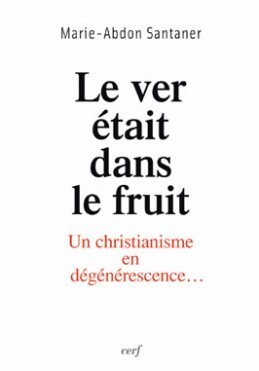
Édition papier
EAN : 9782204086806
Paru le : 16 oct. 2008
20,90 €
19,81 €
Epuisé
Pour connaître votre prix et commander, identifiez-vous
Manquant sans date
Notre engagement qualité
-
 Livraison gratuite
en France sans minimum
de commande -
 Manquants maintenus
en commande
automatiquement -
 Un interlocuteur
unique pour toutes
vos commandes -
 Toutes les licences
numériques du marché
au tarif éditeur -
 Assistance téléphonique
personalisée sur le
numérique -
 Service client
Du Lundi au vendredi
de 9h à 18h
- EAN13 : 9782204086806
- Réf. fournisseur : 775184
- Collection : PAROLE PRESENTE
- Editeur : Cerf
- Date Parution : 16 oct. 2008
- Disponibilite : Manque sans date
- Barème de remise : NS
- Format : H:195 mm L:135 mm E:14 mm
- Poids : 222gr
- Interdit de retour : Retour interdit
-
Résumé :
« Quand l'Évangile devient une doctrine, il cesse d'être source de vie et peut se transformer en principe de mort. » Cette phrase du philosophe Eric Voegelin dit en deux lignes de quelle dégénérescence parle cet ouvrage. L'auteur y analyse, siècle après siècle, la dérive qui, petit à petit, a substitué à la démarche du croire-en-l'autre, vécue par Jésus-Christ, celle de croire des vérités érigées en doctrine. On voit comment cette dérive, au bout d'un certain nombre de siècles, se traduit en bûchers d'Inquisition et guerres de religion. On voit aussi pourquoi le christianisme n'a pas pu empêcher les grands conflits, d'abord entre nations puis entre groupes idéologiques, qui ont dévasté l'Europe et ensuite le monde à partir d'un Occident réputé chrétien. De tels aboutissements obligent à repenser la démarche du croire chrétien pour ce qu'elle est vraiment : une démarche de tout l'être humain, avec son intelligence certes, mais tout autant avec sa volonté et son affectivité. Sous ces deux derniers aspects, même si les théologiens n'en avaient cure, elle n'a jamais cessé d'être vécue dans le peuple croyant, depuis saint Martin et saint François d'Assise jusqu'à saint Vincent de Paul et l'Abbé Pierre. Le pape Jean XXIII en avait l'intuition lorsqu'il fixait comme objectif à Vatican II d'être un concile pastoral et non pas dogmatique. N'est-ce pas un objectif que devrait se donner le christianisme lui-même s'il veut retrouver crédit auprès de tant d'hommes de bonne volonté pour qui il n'est guère qu'une idéologie parmi d'autres ?
--
‘When the Gospel becomes a doctrine, it ceases to be a source of life and can turn into a death principle.' That statement from the philosopher Eric Voegelin describes, in just one sentence, the sort of degeneration this book discusses. The author traces, century after century, the drift that has, little by little, seen the substitution of truths that have been established as doctrines for the ‘believe in others' principle lived by Jesus Christ. We can see how that drifting, after a number of centuries, produced wars of religion and cruel persecution. We can see why Christianity was unable to put a stop to great wars, between nations or ideological groups, wars that devastated Europe, then the world - although they began in a reputedly Christian Europe. All of which obliges us to rethink the principle of Christian belief, and to see it for what it truly is: one that engages the entire human being, his intelligence of course, but also his will and affectivity. In regard to the latter two aspects, even if theologians have paid little attention to them, the principle of Christian belief has never ceased to be practiced among believers, since Saint Martin and Saint Francis of Assisi to Saint Vincent de Paul and Abbé Pierre. Pope John XXIII had this intuition when he fixed the objective for Vatican II as a pastoral council, rather than a dogmatic one. Isn't this the objective that Christianity should set itself, if it hopes to gain the respect of so many men of good will for whom it is not just another ideology? Born in 1921, Marie-Abdon Santaner studied philosophy, theology and the classics and taught in Bayonne before entering the Capuchin Order. Provincial of the Capuchin of Toulouse for three years, he went on to accomplish a ministry of training and retreats in France and abroad. As a theologian, he worked in the service of the Centre national des vocations, then the Episcopal Council for the training of laymen in the diocese of Évry.