Nous utilisons des cookies pour améliorer votre expérience. Pour nous conformer à la nouvelle directive sur la vie privée, nous devons demander votre consentement à l’utilisation de ces cookies. En savoir plus.

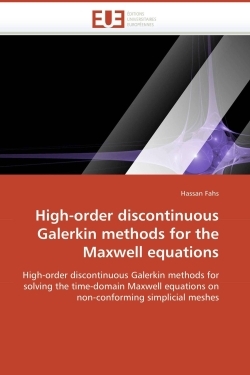
High-order discontinuous galerkin methods for the maxwell equations
Univ Europeenne - EAN : 9786131500206
Édition papier
EAN : 9786131500206
Paru le : 5 juil. 2010
69,00 €
65,40 €
Disponible
Pour connaître votre prix et commander, identifiez-vous
Notre engagement qualité
-
 Livraison gratuite
en France sans minimum
de commande -
 Manquants maintenus
en commande
automatiquement -
 Un interlocuteur
unique pour toutes
vos commandes -
 Toutes les licences
numériques du marché
au tarif éditeur -
 Assistance téléphonique
personalisée sur le
numérique -
 Service client
Du Lundi au vendredi
de 9h à 18h
- EAN13 : 9786131500206
- Réf. fournisseur : 4820292
- Editeur : Univ Europeenne
- Date Parution : 5 juil. 2010
- Disponibilite : Disponible
- Barème de remise : NS
- Nombre de pages : 208
- Format : H:229 mm L:152 mm E:12 mm
- Poids : 313gr
- Interdit de retour : Retour interdit
- Résumé : This work is concerned with the development of a high-order discontinuous Galerkin time-domain (DGTD) method for solving Maxwell's equations on non-conforming simplicial meshes. First, we present a DGTD method based on high-order nodal basis functions for the approximation of the electromagnetic field within a simplex, a centered scheme for the calculation of the numerical flux at an interface between neighbouring elements, and a second-order leap-frog time integration scheme. Next, to reduce the computational costs of the method, we propose a hp-like DGTD method which combines local h-refinement and p-enrichment. Then, we report on a detailed numerical evaluation of the DGTD methods using several propagation problems. Finally, in order to improve the accuracy and rate of convergence of the DGTD methods previously studied, we study a family of high-order explicit leap-frog time schemes. These time schemes ensure the stability under some CFL-like condition. We also establish rigorously the convergence of the semi-discrete approximation to Maxwell's equations and we provide bounds on the global divergence error.
