Nous utilisons des cookies pour améliorer votre expérience. Pour nous conformer à la nouvelle directive sur la vie privée, nous devons demander votre consentement à l’utilisation de ces cookies. En savoir plus.

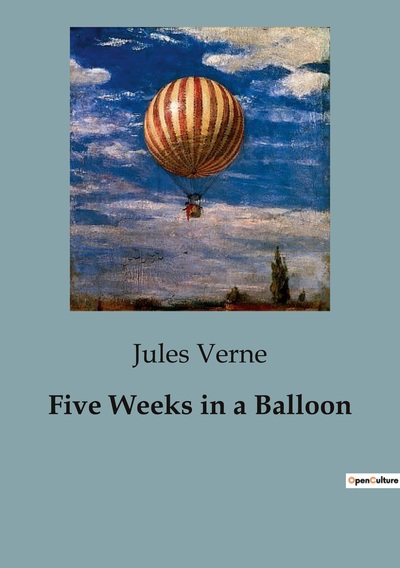
Five Weeks in a Balloon
EAN : 9791041849864
Édition papier
EAN : 9791041849864
Paru le : 23 août 2023
17,00 €
16,11 €
Disponible
Pour connaître votre prix et commander, identifiez-vous
Notre engagement qualité
-
 Livraison gratuite
en France sans minimum
de commande -
 Manquants maintenus
en commande
automatiquement -
 Un interlocuteur
unique pour toutes
vos commandes -
 Toutes les licences
numériques du marché
au tarif éditeur -
 Assistance téléphonique
personalisée sur le
numérique -
 Service client
Du Lundi au vendredi
de 9h à 18h
- EAN13 : 9791041849864
- Réf. fournisseur : 298469
- Date Parution : 23 août 2023
- Disponibilite : Disponible
- Barème de remise : NS
- Nombre de pages : 286
- Format : H:210 mm L:148 mm E:16 mm
- Poids : 374gr
- Résumé : "Five Weeks in a Balloon" by Jules Verne is a pioneering adventure novel that explores the uncharted territories of Africa through the eyes of three intrepid explorers. The story follows Dr. Samuel Fergusson, his servant Joe, and his friend Richard "Dick" Kennedy as they embark on a daring expedition across the African continent in a hydrogen-filled balloon. The novel, first published in 1863, is a blend of scientific curiosity and imaginative storytelling, reflecting Verne's fascination with exploration and technological advancement. The narrative begins with Dr. Fergusson's ambitious plan to traverse Africa from east to west, a journey that had never been accomplished before. The balloon, named the "Victoria," is equipped with the latest scientific instruments and provisions for the journey. As the trio sets off from Zanzibar, they encounter various challenges, including hostile tribes, wild animals, and the harsh African climate. Throughout their journey, Verne provides detailed descriptions of the African landscape, flora, and fauna, showcasing his extensive research and knowledge of the continent. The novel is not only an adventure story but also a commentary on the spirit of exploration and the quest for knowledge. Verne's characters embody the 19th-century ideals of scientific progress and human ingenuity. Dr. Fergusson, in particular, represents the archetype of the rational scientist, using his intellect and resourcefulness to overcome obstacles. The interactions between the characters also highlight themes of friendship, loyalty, and courage. "Five Weeks in a Balloon" is a testament to Verne's ability to weave factual information with fiction, creating a narrative that is both educational and entertaining. The novel's success laid the foundation for Verne's subsequent works, establishing him as a master of the science fiction genre. It remains a classic of adventure literature, inspiring generations of readers to dream of distant lands and the possibilities of human achievement.
- Biographie : Jules Verne naît à Nantes en 1828. Après ses études secondaires, il se rend à Paris pour faire son droit, mais il préfère le théâtre et les mondanités. Bien que reçu à sa thèse, il refuse de reprendre la charge d'avoué de son père. Il commence à se passionner de plus en plus pour la science et l'univers des découvertes. Il publie des nouvelles, un roman historique, Martin Paz, et une opérette, Colin-Maillard. Après son mariage en 1857, il devient agent de change à la Bourse pour vivre. Travaillant le jour, il étudie la nuit, les mathématiques, la physique, la géographie, la botanique pour construire son oeuvre.En 1863, il apporte le manuscrit de Cinq semaines en ballon à l'éditeur Hetzel. Cette rencontre sera décisive : ce grand éditeur, enthousiasmé par les manuscrits de Jules Verne, lui propose un contrat propre à stimuler le génie de l'auteur de Vingt Mille Lieues sous les mers, un contrat qui l'attache à sa maison. Grâce à un travail acharné de quarante années, Jules Verne élabore une oeuvre immense.Pour lui, la science, c'est le mouvement incessant qui part de l'homme et y revient avec une provision de connaissances, d'images et de rêves. Il s'agit d'une science apprivoisée, attentive aux besoins de l'homme, prête à le servir sans jamais l'asservir. On est loin de l'âpre réalité qui avait cours à l'époque. Ce naïf, cet émouvant mélange de connaissances, de bricolage ingénieux, de fulgurantes visions futuristes est toujours à hauteur d'homme. Jules Verne est mort le 24 mars 1905 à Amiens, la ville natale de sa femme, où il s'était installé en 1871.