Nous utilisons des cookies pour améliorer votre expérience. Pour nous conformer à la nouvelle directive sur la vie privée, nous devons demander votre consentement à l’utilisation de ces cookies. En savoir plus.

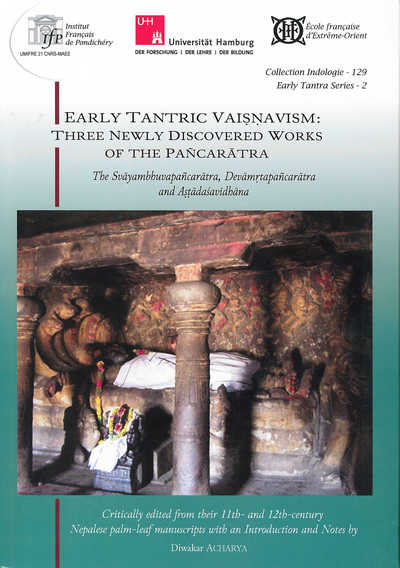
EARLY TANTRA SERIES - T129 - EARLY TANTRIC VAISNAVISM: THREE NEWLY DISCOVERED WORKS OF THE PANCARATR
Efeo - EAN : 9782855391526
Édition papier
EAN : 9782855391526
Paru le : 24 août 2015
30,00 €
28,44 €
Disponible
Pour connaître votre prix et commander, identifiez-vous
Notre engagement qualité
-
 Livraison gratuite
en France sans minimum
de commande -
 Manquants maintenus
en commande
automatiquement -
 Un interlocuteur
unique pour toutes
vos commandes -
 Toutes les licences
numériques du marché
au tarif éditeur -
 Assistance téléphonique
personalisée sur le
numérique -
 Service client
Du Lundi au vendredi
de 9h à 18h
- EAN13 : 9782855391526
- Réf. fournisseur : CI 129
- Collection : COLL. INDOLOGIE
- Editeur : Efeo
- Date Parution : 24 août 2015
- Disponibilite : Disponible
- Barème de remise : NS
- Nombre de pages : 229
- Format : 1.80 x 17.00 x 24.50 cm
- Poids : 650gr
- Interdit de retour : Retour interdit
-
Résumé :
About the book
The three works presented in this volume are hitherto unpublished texts of great significance for the early history of tantric Vaisnavism, and we have grounds for supposing that they are older than any hitherto published Vaisnava Tantras. They preserve archaic elements not found in other Pancaratra works, such as Vaisnava brahma-mantras styled after the Pasupata ones, and the veneration of eight heroes of the Vrsni clan, as well as of the pentad of Varaha, Narasimha, Trivikrama, Vamana, and Vasudeva. Their ritual makes profuse use of Vedic mantras, one of them even requiring the installation of Vedic hymns (rather than tantric mantras!) chosen from each of the ten mandalas of the Ṛgveda in every image of Visnu. In a spirit rare in the Vaisnava traditions of the second millennium, these scriptures call on devotees to identify Brahma, Visnu and Siva. They thus present a picture of Tantric Vaisnavism in the first millennium AD as imbricated with Saivism and Brahmanism and tell us much about the early history of tantrism and of Hinduism in general.
The first and third of these texts are transmitted to us in a single palm-leaf manuscript dated to Nepal Samvat 147 (1027 AD), and the second in a slightly newer and undated one, both from the treasure trove of the National Archives, Kathmandu. This volume contains a first edition of these texts with a detailed introduction, including an English synopsis, along with text-critical notes and indices, as well as facsimiles of the manuscript leaves.
About the author
Diwakar Acharya studied Sanskrit with traditional teachers beginning with his father and at universities in Nepal, India, and Germany. He started his teaching career in 1993 in Nepal and is currently teaching Indian philosophy and classical Sanskrit studies at Kyoto University, Japan. His research covers a wide range of topics in Sanskrit literature, Indian religious and philosophical traditions, and the early history of Nepal. He has published Vacaspatimisra’s Tattvasamiksa: The Earliest Commentary on Mandanamisra’s Brahmasiddhi (2006) and The Little Clay Cart (2009), as well as a number of articles in journals and anthologies.