Nous utilisons des cookies pour améliorer votre expérience. Pour nous conformer à la nouvelle directive sur la vie privée, nous devons demander votre consentement à l’utilisation de ces cookies. En savoir plus.

Death and after?
EAN : 9791041816989
Édition papier
EAN : 9791041816989
Paru le : 19 juin 2023
11,50 €
10,90 €
Disponible
Pour connaître votre prix et commander, identifiez-vous
Notre engagement qualité
-
 Livraison gratuite
en France sans minimum
de commande -
 Manquants maintenus
en commande
automatiquement -
 Un interlocuteur
unique pour toutes
vos commandes -
 Toutes les licences
numériques du marché
au tarif éditeur -
 Assistance téléphonique
personalisée sur le
numérique -
 Service client
Du Lundi au vendredi
de 9h à 18h
- EAN13 : 9791041816989
- Réf. fournisseur : 288527
- Date Parution : 19 juin 2023
- Disponibilite : Disponible
- Barème de remise : NS
- Nombre de pages : 40
- Format : H:210 mm L:148 mm E:3 mm
- Poids : 67gr
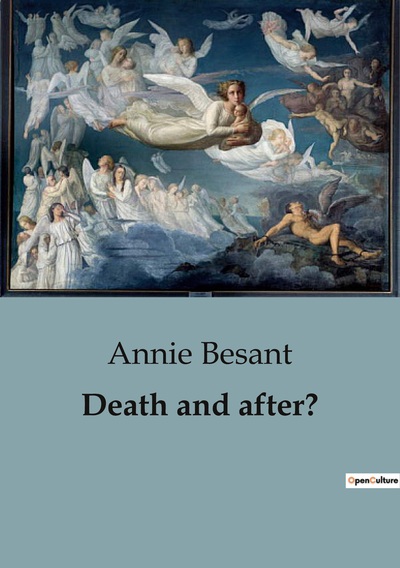
- Résumé : "Death—and After?" by Annie Besant delves into the theosophical understanding of death and the afterlife, offering a comprehensive exploration of the human constitution and the journey of the soul post-mortem. Besant begins by addressing the common fear and misconceptions surrounding death, particularly within Christian traditions, and contrasts these with the more serene perspectives found in ancient religions and theosophy. She outlines the septenary constitution of man, dividing it into the immortal triad (Atma, Buddhi, Manas) and the perishable quaternary (Kama, Prana, Etheric Double, Dense Body). The text explains the process of death as a series of separations, where the soul sheds its physical and etheric bodies, eventually entering Kamaloka, an intermediary state. Here, the soul, still attached to its desires, undergoes a purification process before moving to Devachan, a state of blissful rest. Besant emphasizes the importance of understanding these stages to alleviate the fear of death and to recognize the continuity of consciousness beyond physical existence. She also discusses the potential for communication between the living and the deceased, cautioning against disturbing the natural progression of the soul. The work serves as both a guide and a reassurance, encouraging readers to view death not as an end, but as a passage to a higher state of being.
- Biographie : Conférencière, féministe, libre-penseuse, socialiste et théosophe britannique, Annie Besant (1847-1933) prit part à la lutte ouvrière avant de diriger la Société théosophique, puis de lutter pour l'indépendance de l'Inde. En 1889, William Thomas Stead, rédacteur en chef de la Pall Mall Gazette, lui demanda d'écrire un compte-rendu de l'ouvrage d'Helena Blavatsky, la Doctrine Secrète, qui lui fit découvrir la théosophie. Elle y trouva les réponses à ses interrogations métaphysiques et spirituelles et s'y convertit rapidement. Elle devint une des dirigeantes de la société théosophique. En 1893, elle partit s'installer en Inde où était basée la société. Là, elle adopta et éduqua Krishnamurti pour qui elle devint une mère spirituelle. Elle prit la direction de la Société théosophique en 1907 et l'assuma jusqu'à sa mort en 1933. En Inde, elle s'engagea pour l'auto-détermination, puis l'indépendance du pays, par des articles, des discours et des activités éducatrices. Elle mécontenta le pouvoir britannique qui l'assigna à résidence en 1917 mais dut la relâcher rapidement sous la pression de l'opinion publique indienne. La même année, Annie Besant fut élue présidente du Parti du Congrès. Elle s'effaça peu à peu face à Gandhi et consacra les dernières années de sa vie à la théosophie...