Nous utilisons des cookies pour améliorer votre expérience. Pour nous conformer à la nouvelle directive sur la vie privée, nous devons demander votre consentement à l’utilisation de ces cookies. En savoir plus.

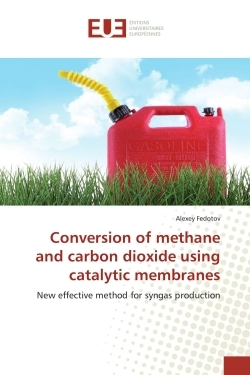
Conversion of methane and carbon dioxide using catalytic membranes
Univ Europeenne - EAN : 9786131574863
Édition papier
EAN : 9786131574863
Paru le : 10 mai 2011
29,00 €
27,49 €
Disponible
Pour connaître votre prix et commander, identifiez-vous
Notre engagement qualité
-
 Livraison gratuite
en France sans minimum
de commande -
 Manquants maintenus
en commande
automatiquement -
 Un interlocuteur
unique pour toutes
vos commandes -
 Toutes les licences
numériques du marché
au tarif éditeur -
 Assistance téléphonique
personalisée sur le
numérique -
 Service client
Du Lundi au vendredi
de 9h à 18h
- EAN13 : 9786131574863
- Réf. fournisseur : 5114617
- Editeur : Univ Europeenne
- Date Parution : 10 mai 2011
- Disponibilite : Disponible
- Barème de remise : NS
- Nombre de pages : 72
- Format : H:220 mm L:150 mm
- Poids : 120gr
- Interdit de retour : Retour interdit
- Résumé : This study reports the development of a new process to convert methane and carbon dioxide into syngas from non-oil resources. The process uses membrane catalytic systems (MCS) that support heterogeneous catalytic reactions in gaseous phase in membrane channels. An active surface of the catalysts formed inside the micro- channels is low in term of area, but it is characterized by a high value of the catalyst surface/volume ratio, which induces a high efficiency of heterogeneous catalysis. Such MCS, having 10 8 pores per cm2 of surface, can be considered as a set of nano reactors. MCS are formed from alkoxy derivatives and precursor metal complex containing between 0.008 and 0.055% by weight of nano- components mono-and bimetallic active distributed evenly in the channels. For systems La-Ce/Ni-Al and Pd-Mn/Ni-Al, productivities of 10500 and 7500 l/h dm3 were respectively obtained at 650°C with a composition of syngas H2/ ranging from 0.63 to 1.25 and a conversion rate of 50% with a CH4/ 2 (1/1) feed. Thus MCS is an order of magnitude more efficient than a fixed bed reactor of the same catalyst. A catalytic synergy has been demonstrated for the system Pd-Mn.
- Biographie : Alexey Fedotov, 1983. 2000-2006 D.Mendeleyev University ofChemical Technology of Russia, Chair of Technology of Basic Organic and PetrochemicalSynthesis. 2006-2009 The Joint Russian-French postgraduate study between A.V. TopchievInstitute of Petrochemical Synthesis, Russian Academy of Sciences and NationalPolytechnic Institute of Lorraine.
