Nous utilisons des cookies pour améliorer votre expérience. Pour nous conformer à la nouvelle directive sur la vie privée, nous devons demander votre consentement à l’utilisation de ces cookies. En savoir plus.

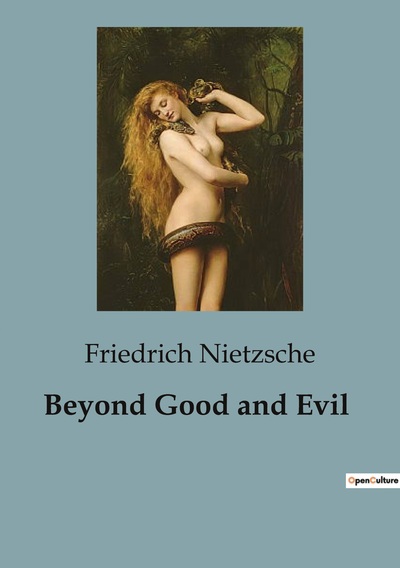
Beyond Good and Evil
EAN : 9791041820801
Édition papier
EAN : 9791041820801
Paru le : 11 oct. 2023
16,00 €
15,17 €
Disponible
Pour connaître votre prix et commander, identifiez-vous
Notre engagement qualité
-
 Livraison gratuite
en France sans minimum
de commande -
 Manquants maintenus
en commande
automatiquement -
 Un interlocuteur
unique pour toutes
vos commandes -
 Toutes les licences
numériques du marché
au tarif éditeur -
 Assistance téléphonique
personalisée sur le
numérique -
 Service client
Du Lundi au vendredi
de 9h à 18h
- EAN13 : 9791041820801
- Réf. fournisseur : 308802
- Date Parution : 11 oct. 2023
- Disponibilite : Disponible
- Barème de remise : NS
- Nombre de pages : 128
- Format : H:210 mm L:148 mm E:7 mm
- Poids : 177gr
- Résumé : "Beyond Good and Evil" is a collection of aphorisms and essays in which Friedrich Nietzsche explores a wide range of philosophical and moral themes. The book is divided into nine parts, each containing a series of short, often provocative, and thought-provoking passages. Nietzsche begins by challenging traditional moral and philosophical concepts, including the notions of good and evil. He argues that conventional moral values are often shaped by the interests and prejudices of those in power and that they inhibit individual freedom and creativity. Throughout the book, Nietzsche critiques various philosophical and cultural ideas, including religion, metaphysics, morality, and democracy. He calls for a reevaluation of these concepts and a reexamination of our understanding of truth, knowledge, and ethics. Nietzsche introduces the idea of the "will to power," which he sees as a fundamental driving force behind human actions and desires. He suggests that individuals should embrace their instincts and desires rather than suppress them in the name of conventional morality. The book also contains Nietzsche's criticisms of various philosophers and thinkers, including Immanuel Kant, Arthur Schopenhauer, and Socrates, among others. He encourages readers to think critically and independently, to question the status quo, and to live authentically. "Beyond Good and Evil" is known for its aphoristic and often enigmatic style, which challenges readers to engage with its ideas and draw their conclusions. Nietzsche's work has had a significant impact on existentialism, postmodern philosophy, and the broader field of Western philosophy. It continues to be studied and debated for its profound and sometimes controversial insights into the nature of morality, truth, and human existence.
- Biographie : Friedrich Nietzsche est né à Röcken, près de Leipzig et Lützen, le 15 octobre 1844. Après ses études, il occupe la chaire de philologie classique de l'université de Bâle, fréquentant le milieu intellectuel bâlois et Richard Wagner avec qui il se brouillera en 1878. Gravement malade, relevé de ses fonctions de professeur à sa demande, il mène une vie errante entre Sils-Maria, Nice, Menton et plusieurs villes italiennes. Frappé de folie au début de 1889, il meurt le 25 août 1900 à Weimar. Friedrich Nietzsche fut le penseur qui soumit à un doute radical tout l'acquis de la pensée occidentale. Il est à ce titre l'un des piliers de la modernité.