Nous utilisons des cookies pour améliorer votre expérience. Pour nous conformer à la nouvelle directive sur la vie privée, nous devons demander votre consentement à l’utilisation de ces cookies. En savoir plus.

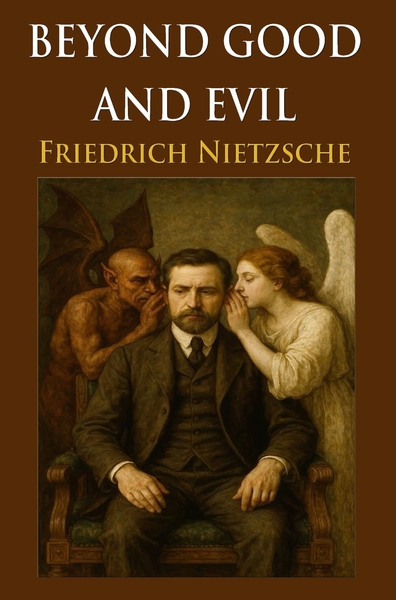
BEYOND GOOD AND EVIL
EAN : 9789403860718
Édition papier
EAN : 9789403860718
Paru le : 20 janv. 2026
19,99 €
18,95 €
Disponible
Pour connaître votre prix et commander, identifiez-vous
Notre engagement qualité
-
 Livraison gratuite
en France sans minimum
de commande -
 Manquants maintenus
en commande
automatiquement -
 Un interlocuteur
unique pour toutes
vos commandes -
 Toutes les licences
numériques du marché
au tarif éditeur -
 Assistance téléphonique
personalisée sur le
numérique -
 Service client
Du Lundi au vendredi
de 9h à 18h
- EAN13 : 9789403860718
- Réf. fournisseur : 1696446
- Date Parution : 20 janv. 2026
- Disponibilite : Disponible
- Barème de remise : NS
- Nombre de pages : 247
- Format : 1.40 x 15.60 x 23.40 cm
- Poids : 354gr
- Interdit de retour : Retour interdit
- Résumé : Beyond Good and Evil: Prelude to a Philosophy of the Future (German: Jenseits von Gut und Böse: Vorspiel einer Philosophie der Zukunft) is a book by philosopher Friedrich Nietzsche that covers ideas in his previous work Thus Spoke Zarathustra but with a more polemical approach. It was first published in 1886 under the publishing house C. G. Naumann of Leipzig at the author's own expense and first translated into English by Helen Zimmern, who was two years younger than Nietzsche and knew the author. According to translator Walter Kaufman, the title refers to the need for moral philosophy to go beyond simplistic black and white moralizing, as contained in statements such as "X is good" or "X is evil". At the beginning of the book, Nietzsche attacks the very idea of using strictly opposite terms such as "Good versus Evil". In Beyond Good and Evil, Nietzsche accuses past philosophers of lacking critical sense and blindly accepting dogmatic premises in their consideration of morality.
- Biographie : Friedrich Wilhelm Nietzsche (15 October 1844 - 25 August 1900) was a German philosopher. He began his career as a classical philologist, turning to philosophy early in his academic career. In 1869, aged 24, Nietzsche became the youngest professor to hold the Chair of Classical Philology at the University of Basel. Plagued by health problems for most of his life, he resigned from the university in 1879, and in the following decade he completed much of his core writing. In 1889, aged 44, he suffered a collapse and thereafter a complete loss of his mental faculties, with paralysis and vascular dementia, living his remaining 11 years under the care of his family until his death. His works and his philosophy have fostered not only extensive scholarship but also much popular interest.