Nous utilisons des cookies pour améliorer votre expérience. Pour nous conformer à la nouvelle directive sur la vie privée, nous devons demander votre consentement à l’utilisation de ces cookies. En savoir plus.

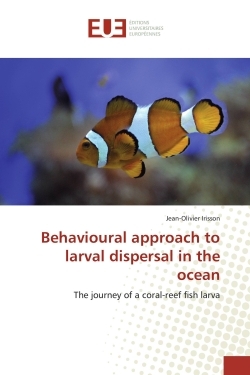
Behavioural approach to larval dispersal in the ocean
Univ Europeenne - EAN : 9786131527401
Édition papier
EAN : 9786131527401
Paru le : 25 août 2010
69,00 €
65,40 €
Disponible
Pour connaître votre prix et commander, identifiez-vous
Notre engagement qualité
-
 Livraison gratuite
en France sans minimum
de commande -
 Manquants maintenus
en commande
automatiquement -
 Un interlocuteur
unique pour toutes
vos commandes -
 Toutes les licences
numériques du marché
au tarif éditeur -
 Assistance téléphonique
personalisée sur le
numérique -
 Service client
Du Lundi au vendredi
de 9h à 18h
- EAN13 : 9786131527401
- Réf. fournisseur : 4500909
- Editeur : Univ Europeenne
- Date Parution : 25 août 2010
- Disponibilite : Disponible
- Barème de remise : NS
- Nombre de pages : 236
- Format : H:220 mm L:150 mm
- Poids : 353gr
- Interdit de retour : Retour interdit
- Résumé : Most marine organisms that live near the coast broadcast their eggs and larvae into the vast expanses of the ocean. In many species, this pelagic episode is the sole opportunity for dispersal. As such, it structures the connections between populations which, in turn, determine the demography and genetic composition of coastal communities. Contrary to common belief, these "larvae" are not just drafts of the adults, passively roaming the ocean; they are very specialised organisms, often tightly adapted to their environment. In this book, I strive to evaluate the consequences of the behaviour of fish larvae during their pelagic life. I present experimental approaches to quantify larval orientation and swimming in situ. I detail the analysis of data collected during an oceanographic cruise to characterise the distribution of larvae in three dimensions and understand physical-biological interactions in the ocean. Finally, I introduce a novel modelling framework, drawing from cost minimisation techniques traditionally used in economics or in the optimal foraging theory, which allows to integrate larval behaviour into Lagrangian models of larval dispersal.
- Biographie : Jean-Olivier Irisson has a PhD in marine ecology. He prepared histhesis at the École Pratique des Hautes Études in Perpignan,southern France, and was a post-doctoral scholar at the University of Miami, Florida. He now works on theecology of plankton as an associate professor at the ObservatoireOcéanologique of Villefranche-sur-Mer.
