Nous utilisons des cookies pour améliorer votre expérience. Pour nous conformer à la nouvelle directive sur la vie privée, nous devons demander votre consentement à l’utilisation de ces cookies. En savoir plus.

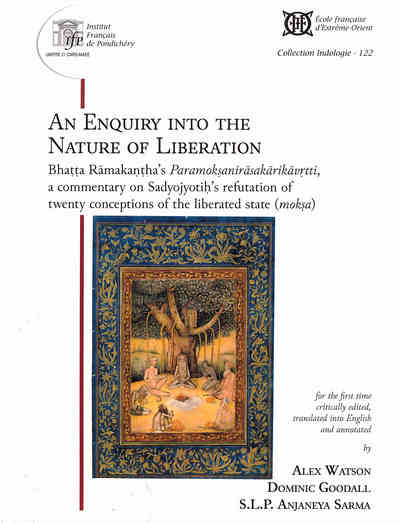
An Enquiry into the Nature of Liberation.
Efeo - EAN : 9782855391304
Édition papier
EAN : 9782855391304
Paru le : 16 mai 2013
38,00 €
36,02 €
Disponible
Pour connaître votre prix et commander, identifiez-vous
Notre engagement qualité
-
 Livraison gratuite
en France sans minimum
de commande -
 Manquants maintenus
en commande
automatiquement -
 Un interlocuteur
unique pour toutes
vos commandes -
 Toutes les licences
numériques du marché
au tarif éditeur -
 Assistance téléphonique
personalisée sur le
numérique -
 Service client
Du Lundi au vendredi
de 9h à 18h
- EAN13 : 9782855391304
- Réf. fournisseur : CI 122
- Collection : COLL.INDOLOGIE
- Editeur : Efeo
- Date Parution : 16 mai 2013
- Disponibilite : Disponible
- Barème de remise : NS
- Nombre de pages : 508
- Format : H:230 mm L:180 mm E:25 mm
- Poids : 900gr
- Interdit de retour : Retour interdit
-
Résumé :
An Enquiry into the Nature of Liberation : Bhatta Ramakantha’s Paramoksanirasakarikavrtti, a commentary on Sadyojyotih’s refutation of twenty conceptions of the liberated state (moksa).
Edited, translated into English and annotated by Alex Watson, Dominic Goodall, S.L.P. Anjaneya Sarma
This book presents a short philosophical treatise in which twenty rival theories of the liberated state (moksa) are introduced and countered, and a long, discursive commentary that explores and develops the arguments that the treatise advances or implies. The original treatise comprises fifty-nine Sanskrit verses composed by Sadyojyotih (c. 675–725 AD), the earliest named Saiva philosopher of the Mantramarga of whom works survive. The commentator, Bhatta Ramakantha (c. 950–1000 AD), was a Kashmirian whose writings systematised the doctrines of the classical Saiva Siddhanta, for some centuries the dominant school of tantric Saivism.
Presented here is a first critical edition of these interlinked works and a richly annotated English translation. A lightly annotated introduction lays out clearly the ideas that the edited texts expound. Their study casts light not only on the history of Saiva thought, but also on a number of religio-philosophical doctrines for which little other testimony survives.
Keywords: Liberation (moksa), Saiva siddhanta, Indian philosophy, Hindu theology, Saivism, Sanskrit philology, Sadyojyotih, Ramakantha