Nous utilisons des cookies pour améliorer votre expérience. Pour nous conformer à la nouvelle directive sur la vie privée, nous devons demander votre consentement à l’utilisation de ces cookies. En savoir plus.

After London
EAN : 9791041800315
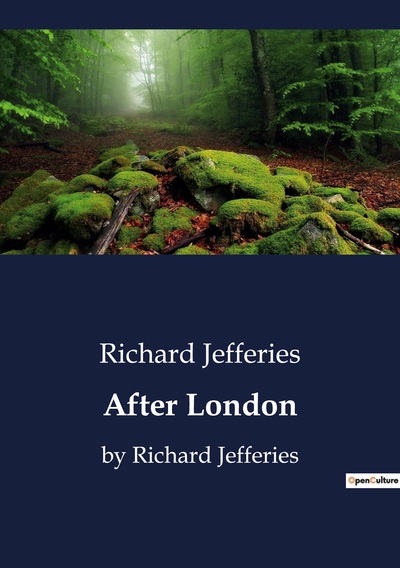
Édition papier
EAN : 9791041800315
Paru le : 3 mars 2023
22,95 €
21,75 €
Disponible
Pour connaître votre prix et commander, identifiez-vous
Notre engagement qualité
-
 Livraison gratuite
en France sans minimum
de commande -
 Manquants maintenus
en commande
automatiquement -
 Un interlocuteur
unique pour toutes
vos commandes -
 Toutes les licences
numériques du marché
au tarif éditeur -
 Assistance téléphonique
personalisée sur le
numérique -
 Service client
Du Lundi au vendredi
de 9h à 18h
- EAN13 : 9791041800315
- Réf. fournisseur : 293536
- Date Parution : 3 mars 2023
- Disponibilite : Disponible
- Barème de remise : NS
- Nombre de pages : 294
- Format : H:210 mm L:148 mm E:16 mm
- Poids : 383gr
- Résumé : "After London; Or, Wild England" by Richard Jefferies is a post-apocalyptic novel that envisions a future where England has reverted to a state of wilderness and barbarism following an unspecified catastrophe. The narrative is divided into two parts: "The Relapse into Barbarism" and "Wild England." In the first part, Jefferies describes the transformation of the English landscape as nature reclaims the land. Fields become overgrown with forests, and wild animals, including feral cats, dogs, and cattle, roam freely. The second part focuses on the human societies that emerge in this new world. The remnants of civilization are scattered into small, isolated communities, each with its own governance and struggles. The novel explores the dynamics between different groups, including the Bushmen, who live primitively in the woods, and the Romany, who maintain a nomadic lifestyle. The narrative also delves into the conflicts between these groups and the more organized societies that have formed around the central lake. Jefferies uses this setting to reflect on themes of civilization, nature, and the cyclical nature of history, suggesting that human progress is fragile and can easily be undone.
- Biographie : Richard Jefferies, an English writer born in 1848 and deceased in 1887, is recognized as a passionate observer of nature and rural life. Coming from a farming family in Wiltshire, he drew on his childhood in the countryside for the subject matter of his works, describing with accuracy and sensitivity the landscapes, customs, and characters of rural England. His novels and essays, including Greene Ferne Farm, demonstrate a deep knowledge of nature and an intimate connection with the land. Jefferies stands out for writing that is both realistic and poetic, capable of capturing the fleeting beauty of the seasons and the complexity of human relationships in villages. He is considered one of the great authors of the English pastoral novel, influencing literature about the countryside for generations. Beyond fiction, Richard Jefferies distinguished himself with reflections on ecology, agriculture, and the place of humans in nature. His work, marked by nostalgia for a changing world, continues to attract readers seeking authenticity, simplicity, and harmony with the environment.