Nous utilisons des cookies pour améliorer votre expérience. Pour nous conformer à la nouvelle directive sur la vie privée, nous devons demander votre consentement à l’utilisation de ces cookies. En savoir plus.

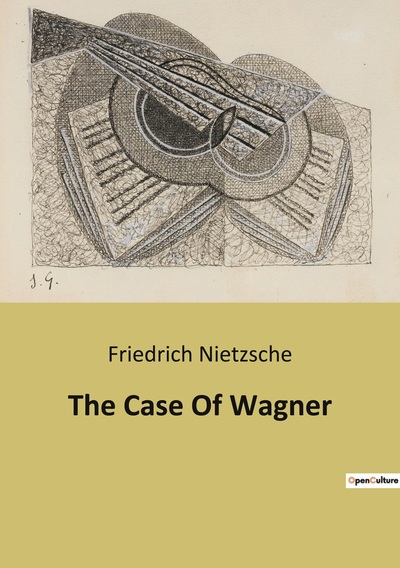
THE CASE OF WAGNER - THE DICHOTOMY OF ART AND DECADENCE IN WAGNER'S INFLUENCE
EAN : 9791041940714
Édition papier
EAN : 9791041940714
Paru le : 21 déc. 2022
24,00 €
22,75 €
Disponible
Pour connaître votre prix et commander, identifiez-vous
Notre engagement qualité
-
 Livraison gratuite
en France sans minimum
de commande -
 Manquants maintenus
en commande
automatiquement -
 Un interlocuteur
unique pour toutes
vos commandes -
 Toutes les licences
numériques du marché
au tarif éditeur -
 Assistance téléphonique
personalisée sur le
numérique -
 Service client
Du Lundi au vendredi
de 9h à 18h
- EAN13 : 9791041940714
- Réf. éditeur : 257716
- Date Parution : 21 déc. 2022
- Disponibilite : Disponible
- Barème de remise : NS
- Nombre de pages : 100
- Format : 0.60 x 14.80 x 21.00 cm
- Poids : 142gr
- Résumé : In "The Case of Wagner," Friedrich Nietzsche presents a critical examination of Richard Wagner's influence on music and culture, positioning Wagner as both a symptom and a catalyst of modern decadence. Nietzsche begins by contrasting Wagner's music with that of Bizet, praising the latter for its clarity, simplicity, and ability to inspire philosophical thought. He argues that Wagner's music, characterized by its complexity and emotional intensity, reflects a deeper cultural malaise. Nietzsche suggests that Wagner's art is a manifestation of decadence, marked by a decline in vitality and an overindulgence in emotional excess. He critiques Wagner's tendency to prioritize dramatic effect over musical integrity, describing his compositions as symptomatic of a broader cultural decline. Nietzsche also explores the psychological and physiological aspects of Wagner's influence, suggesting that his music appeals to those who are exhausted or weakened, offering a temporary escape rather than genuine enrichment. Throughout the essay, Nietzsche employs a mix of humor and seriousness to convey his argument, ultimately positioning Wagner as a figure who embodies the contradictions and challenges of modernity. By examining Wagner's impact on art and society, Nietzsche invites readers to consider the broader implications of cultural and artistic trends, urging a return to simplicity, health, and genuine creativity.
- Biographie : Friedrich Wilhelm Nietzsche est un philologue, philosophe, poète et musicien allemand. L'oeuvre de Nietzsche est essentiellement une critique de la culture occidentale moderne et de l'ensemble de ses valeurs morales (issues de la dévaluation chrétienne du monde), politiques (la démocratie, l'égalitarisme), philosophiques (le platonisme et toutes les formes de dualisme métaphysique) et religieuses (le christianisme). Nietzsche philosophe au marteau. Sa philosophie est volontiers lyrique, et aphoristique, se permettant certaines contradictions.