Nous utilisons des cookies pour améliorer votre expérience. Pour nous conformer à la nouvelle directive sur la vie privée, nous devons demander votre consentement à l’utilisation de ces cookies. En savoir plus.

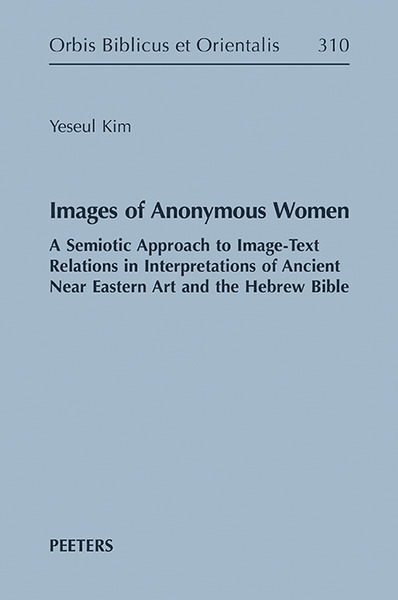
Images of Anonymous Women
EAN : 9789042957732
Édition papier
EAN : 9789042957732
Paru le : 16 juil. 2026
127,20 €
120,57 €
Disponible
Pour connaître votre prix et commander, identifiez-vous
Notre engagement qualité
-
 Livraison gratuite
en France sans minimum
de commande -
 Manquants maintenus
en commande
automatiquement -
 Un interlocuteur
unique pour toutes
vos commandes -
 Toutes les licences
numériques du marché
au tarif éditeur -
 Assistance téléphonique
personalisée sur le
numérique -
 Service client
Du Lundi au vendredi
de 9h à 18h
- EAN13 : 9789042957732
- Collection : ORBIS BIBLICUS
- Date Parution : 16 juil. 2026
- Disponibilite : Disponible
- Barème de remise : NS
- Nombre de pages : 372
- Format : 2.30 x 16.50 x 24.50 cm
- Poids : 840gr
-
Résumé :
Interpretation is a comprehensive act involving various sign systems, both visual and verbal. While viewers of images construct narratives when interpreting them, readers build interpretations of texts through related visual imagery. When images and texts thus become inseparable in interpretation, an adequate method for analyzing both within an isomorphic framework is required. In this volume, Kim introduces semiotics as a transdisciplinary method and presents two semiotic models to support a meta-critical analysis of both textual and visual interpretations. These models are applied to interpretations of two anonymous women from the ancient Near East: a nude woman depicted on an Old Babylonian terracotta plaque, and a woman described in chapter 7 of the biblical Song of Songs. For each case, Kim presents her own interpretation alongside analyses of two contemporary interpretations: those of Zainab Bahrani and Julia Assante for the Old Babylonian figure, and those of Othmar Keel and Fiona Black for the biblical text.
The semiotic analysis reveals unique interpretations, each of which emerges from an interplay between the studied works’ inherent ambiguity or polysemy and the interpreters’ personal preferences. The diverse backgrounds of the latter – academic, feminist, or cultural – and their strategies for relating images to texts – whether historical, thematic, semiotic, or grotesque – fill the works’ inenarrable or invisible gaps in distinctive ways, highlighting the crucial role every interpreter plays in producing his or her interpretation. Kim emphasizes the significance of subjectivity in every interpretation: it is only when the subjectivity of any interpretation is recognized that the interpreter may become the focal point of semiotic analysis, an analysis which aims to move beyond the image-text dichotomy. Grounded in semiotic methodology, the model of a tripartite relationship between image, text, and interpreter offers a significant advance beyond the image-text binary which persists in Hebrew Bible and Ancient Near Eastern studies.