Nous utilisons des cookies pour améliorer votre expérience. Pour nous conformer à la nouvelle directive sur la vie privée, nous devons demander votre consentement à l’utilisation de ces cookies. En savoir plus.

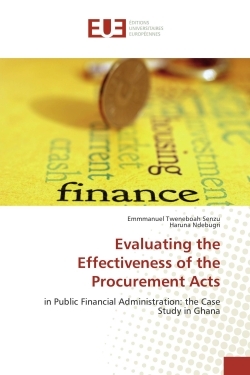
Evaluating the Effectiveness of the Procurement Acts
Univ Europeenne - EAN : 9786202268158
Édition papier
EAN : 9786202268158
Paru le : 1 févr. 2018
35,90 €
34,03 €
Disponible
Pour connaître votre prix et commander, identifiez-vous
Notre engagement qualité
-
 Livraison gratuite
en France sans minimum
de commande -
 Manquants maintenus
en commande
automatiquement -
 Un interlocuteur
unique pour toutes
vos commandes -
 Toutes les licences
numériques du marché
au tarif éditeur -
 Assistance téléphonique
personalisée sur le
numérique -
 Service client
Du Lundi au vendredi
de 9h à 18h
- EAN13 : 9786202268158
- Réf. fournisseur : 8819645
- Editeur : Univ Europeenne
- Date Parution : 1 févr. 2018
- Disponibilite : Disponible
- Barème de remise : NS
- Nombre de pages : 52
- Format : H:229 mm L:152 mm E:3 mm
- Poids : 92gr
- Interdit de retour : Retour interdit
- Résumé : Effective financial management and procurement systems have being one of the developmental challenges facing most developing countries in Sub-Saharan Africa, and Ghana is no exception. According to Sarfo and Baah-Mintah (2013) financial management, especially public financial management is an attempt made by government to ensure that consistently, the budget is either in balanced or a surplus type. These are largely achieved through ensuring adequate receipts from taxes and non-tax sources, and reducing public expenditure levels. In Ghana, public procurement is a major activity of government that generates important financial resources and has been viewed as part of a wider reform agenda targeted at improving public financial management (Republic of Ghana, 2001). The primary concept of procurement is based on the premise that advanced planning, scheduling, and group buying would result in cost savings, more efficient organizational operation, and therefore improve transparency and accountability.
