Nous utilisons des cookies pour améliorer votre expérience. Pour nous conformer à la nouvelle directive sur la vie privée, nous devons demander votre consentement à l’utilisation de ces cookies. En savoir plus.

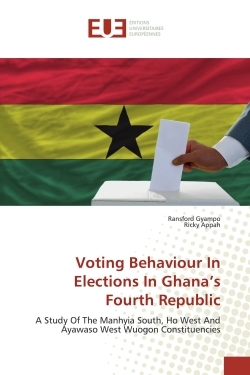
Voting Behaviour In Elections In Ghana's Fourth Republic
Univ Europeenne - EAN : 9786138430834
Édition papier
EAN : 9786138430834
Paru le : 1 nov. 2018
72,00 €
68,25 €
Disponible
Pour connaître votre prix et commander, identifiez-vous
Notre engagement qualité
-
 Livraison gratuite
en France sans minimum
de commande -
 Manquants maintenus
en commande
automatiquement -
 Un interlocuteur
unique pour toutes
vos commandes -
 Toutes les licences
numériques du marché
au tarif éditeur -
 Assistance téléphonique
personalisée sur le
numérique -
 Service client
Du Lundi au vendredi
de 9h à 18h
- EAN13 : 9786138430834
- Réf. fournisseur : 4902180
- Editeur : Univ Europeenne
- Date Parution : 1 nov. 2018
- Disponibilite : Disponible
- Barème de remise : NS
- Nombre de pages : 176
- Format : H:229 mm L:152 mm E:10 mm
- Poids : 268gr
- Interdit de retour : Retour interdit
- Résumé : Using qualitative research design, the study aimed at ascertaining the accuracy of the description of voting behaviour among Ghanaians as ethnic-based. Three constituencies were selected from three administrative regions of the country. These are the Manhyia South, Ho West, and Ayawaso West Wuogon constituencies. Whereas Manhyia South and Ho West constituencies (from Ashanti and Volta Regions) are perceived as areas that vote under ethnic influences, the Ayawaso West Wuogon Constituency in the Greater Accra Region is seen as an area where ethnicity plays virtually no role in shaping voter behaviour. Empirical data from the three case studies show that it is inaccurate to describe the current voting behaviour of Ghana as ethnic-based. Indeed, the impact of ethnicity on voting choices of Ghanaians continue to wane. As a matter of fact, contrary to the popular notion of ethnicity being the most dominant factor that shapes the voting behaviour of Ghanaians, it is rather party identification that stands out as the most dominant determinant of voting among Ghanaian voters.
