Nous utilisons des cookies pour améliorer votre expérience. Pour nous conformer à la nouvelle directive sur la vie privée, nous devons demander votre consentement à l’utilisation de ces cookies. En savoir plus.

Pots and Graves
Libre De Bruxel - EAN : 9782960202953
Édition papier
EAN : 9782960202953
Paru le : 22 janv. 2025
35,00 €
33,18 €
Epuisé
Arrêt définitif de commercialisation
Notre engagement qualité
-
 Livraison gratuite
en France sans minimum
de commande -
 Manquants maintenus
en commande
automatiquement -
 Un interlocuteur
unique pour toutes
vos commandes -
 Toutes les licences
numériques du marché
au tarif éditeur -
 Assistance téléphonique
personalisée sur le
numérique -
 Service client
Du Lundi au vendredi
de 9h à 18h
- EAN13 : 9782960202953
- Collection : ETUDES D ARCHEO
- Editeur : Libre De Bruxel
- Date Parution : 22 janv. 2025
- Disponibilite : Epuisé
- Barème de remise : NS
- Nombre de pages : 176
- Poids : 750gr
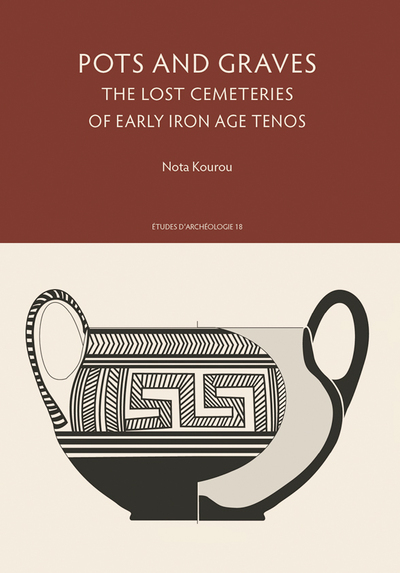
- Résumé : Despite their apparently small populations, Early Iron Age Cycladic communities managed to gradually develop distinctive and wide-ranging cultures, as is reflected in the variety of Late Geometric and Archaic pottery styles. But consecutive and comprehensible contexts of the Protogeometric and earlier Geometric periods are limited and incompletely preserved. With only few exceptions the evidence is basically confined to sporadic and chance finds. Graves of this period are known only from a few islands and Tenos is one of them. A small number of tombs excavated at the beginning of the 20th century and a number of pots from destroyed and lost graves formed for a long time the nucleus of Early Iron Age evidence for the island. Later, further chance finds improved the evidence, but still the Early Iron Age funerary horizon remained poorly known. This study investigates the Early Iron Age funerary record of the island, bringing together all the known material from Tenos and then setting it against its contemporary Aegean background. A detailed catalogue of excavated and lost graves and their finds is presented and discussed from a range of viewpoints. A brief chronological outline of mortuary assemblages and the chance vases is given, to better order the investigation in time. By analyzing the burial record and its contextual background conclusions are drawn on the burial topography and in turn the social and historical implications that emerge for the island. Emphasis is given to the ceramic record and the identification of local pottery workshops and imports. A short review of the history of each shape gives the contemporary ceramic background for each in the Aegean; this is followed by a discussion of pottery styles, networks and intercultural relationships. Pottery analysis demonstrates two successive ceramic phases with different cultural orientations. Thus, we may enhance our knowledge of Tenian culture in the Early Iron Age on the basis of the existing funerary evidence.