Nous utilisons des cookies pour améliorer votre expérience. Pour nous conformer à la nouvelle directive sur la vie privée, nous devons demander votre consentement à l’utilisation de ces cookies. En savoir plus.

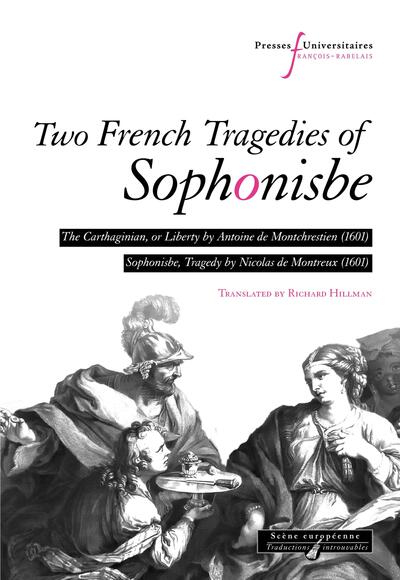
TWO FRENCH TRAGEDIES OF SOPHONISBE - THE CARTHAGINIAN, OR LIBERTY, BY ANTOINE DE MONTCHRESTIEN (1601
Rabelais - EAN : 9782386050527
Édition papier
EAN : 9782386050527
Paru le : 19 mars 2026
32,00 €
30,33 €
Bientôt disponible
Pour connaître votre prix et commander, identifiez-vous
A paraître 19 mars 2026
Notre engagement qualité
-
 Livraison gratuite
en France sans minimum
de commande -
 Manquants maintenus
en commande
automatiquement -
 Un interlocuteur
unique pour toutes
vos commandes -
 Toutes les licences
numériques du marché
au tarif éditeur -
 Assistance téléphonique
personalisée sur le
numérique -
 Service client
Du Lundi au vendredi
de 9h à 18h
- EAN13 : 9782386050527
- Réf. éditeur : 416230
- Collection : SCENE EUROPEENN
- Editeur : Rabelais
- Date Parution : 19 mars 2026
- Disponibilite : Pas encore paru
- Barème de remise : NS
- Poids : 0gr
- Résumé : The fascinating story of the Numidian queen Sophonisbe (235-203 BCE) naturally commanded the attention of Roman historians, most notably Livy and Appian, given the strategic importance of her role towards the end of the second Punic war (218-202 BCE). That role, conferred by her position as daughter of the Carthaginian general Hasdrubal, was played out through successive marriages to two rival kings of Numidian factions, Syphax and Massinissa, who were both implicated in shifting intrigues and alliances with the invading Roman forces under the famed general Scipio (later surnamed Africanus). The historians could hardly neglect, moreover, the intensely fraught human dimension of her relations with her husbands, especially Massinissa, who finally fulfilled her wish to facilitate her death rather than face humiliating captivity under Roman rule. The potential for her portrayal as a tragic heroine, whose life and death had much in common with Cleopatra, was further enhanced by the literary elaboration of the subject by Petrarch in his Latin epic Africa (c. 1337-43, pub. 1501). That potential was realised in theatrical form throughout the early modern period, beginning in Italy with the Sofonisba of Giangiorgio Trissino (1515; pub. 1524), which was translated and performed in France under the auspices of Catherine de' Medici in 1556. It was, however, the two turn-of-the century versions composed by Antoine de Montchrestien and Nicolas de Montreux that founded a distinctively French tradition of tragedies on the subject, to be continued by Jean Mairet (1634), Pierre Corneille (1663) and Voltaire (pub. 1770). The key works of Montchrestien and Montreux presented here are notable for adding complexity of characterisation and depth of feeling to the story, and for structuring it dramatically in contrasting ways. Montchrestien emphasises the destructive power of love – to the point of introducing a Fury to emblematise its influence. Montreux's stress is rather on conflicting responses to political circumstances, with Sophonisbe emerging – much on the model of Cleopatra in his own tragedy on that subject – as a heroine whose courageous defiance of forms of masculine power puts to shame not only her royal husbands but the victorious Scipio.
-
Biographie :
Richard Hillman (Centre d’Études Supérieures de la Renaissance, Université de Tours/CNRS), has produced numerous translations, as well as essays and monographs, testifying to his interest in links between early modern England and France, especially with respect to theatre.